Gen AI
ON ARTIFICIAL INTELLIGENCE
PR
ARTIFICIAL INTELLIGENCE SYLLABUS
Module 1 12Hrs
What is Artificial
Intelligence? AI Technique, Level of the Model,Problem Spaces, and Search:
Defining the Problem as a State Space Search, Production Systems, Problem
Characteristics, Production System Characteristics, Issues in the Design of
Search Programs. Heuristic Search
Techniques: Generate-and- Test, Hill Climbing, Best-first Search, Problem
Reduction, Constraint Satisfaction, Means-ends
Analysis, Knowledge
Representation: Representations and Mappings, Approaches to Knowledge
Representation, Using Predicate Logic: Representing Simple Facts in Logic,
Representing Instance and ISA
Relationships, Computable Functions and Predicates, Resolution, Natural
Deduction.Using Rules: Procedural Versus Declarative Knowledge, Logic
Programming, Forward Versus Backward Reasoning,
Matching, Control
Knowledge.Symbolic Reasoning Under Uncertainty: Introduction to Nonmonotonic
Reasoning, Logics for Nonmonotonic Reasoning, Implementation Issues, Augmenting
a Problem-solver, Depth-first Search, Breadthfirst Search.Weak and Strong Slot-and-Filler
Structures: Semantic Nets, Frames, Conceptual Dependency Scripts, CYC.
Module 2 10Hrs
Game Playing: The Minimax Search Procedure, Adding
Alpha-beta Cutoffs, Iterative Deepening.Planning: The Blocks World, Components of a Planning
System, Goal Stack Planning, Nonlinear Planning Using Constraint Posting,
Hierarchical PlanningOther Planning Techniques.Understanding: What is
Understanding, What Makes Understanding Hard?, Understanding as Constraint
Satisfaction.Natural Language Processing: Introduction, Syntactic Processing,
Semantic Analysis, Discourse and Pragmatic Processing, Statistical Natural
Language Processing, Spell Checking.
Module 3 8Hrs
Learning: Rote
Learning, learning by Taking Advice, Learning in Problem-solving, Learning from Examples: Induction, Explanation-based
Learning, Discovery, Analogy, Formal Learning Theory, Neural Net Learning and
Genetic Learning. Expert Systems: Representing and Using Domain Knowledge,
Expert System Shells, Explanation, Knowledge Acquisition.
Text
Book:
1.
Elaine
Rich, Kevin Knight,
& Shivashankar B Nair, Artificial Intelligence, McGraw Hill, 3rd ed.,2009
References:
1) Introduction to Artificial Intelligence & Expert Systems,
Dan W Patterson, PHI.,2010
2) S Kaushik,
Artificial Intelligence, Cengage
Learning, 1st ed.2011
Module 1
ARTIFICIAL INTELLIGENCE
What is Artificial Intelligence?
It is a
branch of Computer Science that pursues creating the computers or machines as intelligent as human beings.
It is the science and engineering of making intelligent
machines, especially intelligent computer programs.
It is related to the similar task of using computers to
understand human intelligence, but AI does not have to confine itself to
methods that are biologically observable
Definition: Artificial Intelligence is the study of how
to make computers do things, which, at the moment, people do better.
According to the father of Artificial Intelligence, John
McCarthy, it is “The science and
engineering of making intelligent machines, especially intelligent computer
programs”.
Artificial Intelligence is a way of making a computer, a computer-controlled robot, or a software think
intelligently, in the similar manner the intelligent humans think.
AI is accomplished by studying how human brain thinks
and how humans learn, decide, and work while trying to solve a problem, and
then using the outcomes of this study as a basis of developing intelligent
software and systems.
It has gained prominence recently due, in part, to big
data, or the increase in speed, size and variety of data businesses are now
collecting. AI can perform tasks such as identifying patterns in the data more efficiently than humans, enabling
businesses to gain more insight
out of their data.
From a business perspective
AI is a set of very powerful tools, and methodologies for using those tools to
solve business problems.
From a programming
perspective, AI includes the study of symbolic programming, problem
solving, and search.
AI Vocabulary
Intelligence relates to tasks involving higher mental processes, e.g. creativity,
solving problems, pattern recognition, classification, learning, induction,
deduction, building analogies, optimization, language processing, knowledge and
many more. Intelligence is the computational part of the ability to achieve
goals.
Intelligent
behaviour is depicted by
perceiving one’s environment, acting in complex environments, learning and
understanding from experience, reasoning to solve problems and discover hidden
knowledge, applying knowledge successfully in new situations, thinking
abstractly, using analogies, communicating with others and more.
Science
based goals of AI pertain to
developing concepts, mechanisms and understanding biological intelligent
behaviour. The emphasis is on understanding intelligent behaviour.
Engineering
based goals of AI relate to
developing concepts, theory and practice of building intelligent machines. The
emphasis is on system building.
AI
Techniques depict how we
represent, manipulate and reason with knowledge in order to solve problems.
Knowledge is a collection of ‘facts’. To manipulate these facts by a program, a
suitable representation is required. A good representation facilitates problem
solving.
Learning
means that programs learn
from what facts or behaviour can represent. Learning denotes changes in the
systems that are adaptive in other words, it enables the system to do the same
task(s) more efficiently next time.
Applications
of AI refers to problem
solving, search and control strategies, speech recognition, natural language
understanding, computer vision, expert systems, etc.
Problems of AI:
Intelligence does not imply perfect understanding; every intelligent being has limited perception, memory and computation. Many points on
the spectrum of intelligence versus cost are viable, from insects to humans. AI
seeks to understand the computations required from intelligent behaviour and to
produce computer systems that exhibit intelligence. Aspects of intelligence
studied by AI include perception, communicational using human languages, reasoning, planning, learning and memory.
The following questions are to be considered before we can step forward:
1. What are the underlying assumptions about intelligence?
2. What kinds of techniques will be useful for solving AI problems?
3. At what level human
intelligence can be modelled?
4. When will it be realized when an intelligent program has been built?
Branches
of AI:
A list of branches of AI is given below.
However some branches are surely missing, because no one has identified them
yet. Some of these may be regarded
as concepts or topics rather than full branches.
Logical
AI — In general the facts of
the specific situation in which it must act, and its goals are all represented
by sentences of some mathematical logical language. The program decides what to
do by inferring that certain actions are appropriate for achieving its goals.
Search
— Artificial Intelligence
programs often examine large numbers of possibilities – for example, moves in a
chess game and inferences by a theorem proving program. Discoveries are
frequently made about how to do this more efficiently in various domains.
Pattern
Recognition — When a program
makes observations of some kind, it is often planned to compare what it sees with a pattern. For example, a vision
program may try to match a pattern of eyes and a nose in
a scene in order to find a face. More complex patterns are like a natural
language text, a chess position or in the history of some event. These more
complex patterns require quite different methods than do the simple patterns
that have been studied the most.
Representation
— Usually languages of mathematical logic are used to represent the facts about the world.
Inference
— Others can be inferred from
some facts. Mathematical logical deduction is sufficient for some purposes, but
new methods of non-monotonic inference
have been added to the logic since the 1970s. The simplest kind of
non-monotonic reasoning is default reasoning in which a conclusion is to be
inferred by default. But the conclusion can be withdrawn if there is evidence
to the divergent. For example, when we hear of a bird, we infer that it can
fly, but this conclusion can be reversed when we hear that it is a penguin. It
is the possibility that a conclusion
may have to be withdrawn that constitutes the non-monotonic character of the
reasoning. Normal logical reasoning is monotonic, in that the set of
conclusions can be drawn from a set of premises, i.e. monotonic increasing
function of the premises. Circumscription is another form of non-monotonic
reasoning.
Common
sense knowledge and Reasoning — This
is the area in which AI is farthest from the human level, in spite of the fact
that it has been an active research area since the 1950s. While there has been
considerable progress in developing systems of non-monotonic reasoning and theories of action, yet more new ideas
are needed.
Learning
from experience — There are
some rules expressed in logic for learning. Programs can only learn what facts or behaviour their
formalisms can represent, and unfortunately learning systems are almost all based on very limited abilities
to represent information.
Planning
— Planning starts with
general facts about the world (especially facts about the effects of actions),
facts about the particular situation and a statement of a goal. From these,
planning programs generate a strategy for achieving the goal. In the most common
cases, the strategy is just a sequence of actions.
Epistemology
— This is a study of the
kinds of knowledge that are required for solving problems in the world.
Ontology
— Ontology is the study of
the kinds of things that exist. In AI the programs and sentences deal with
various kinds of objects and we study what these kinds are and what their basic
properties are. Ontology assumed importance from the 1990s.
Heuristics
— A heuristic is a way of
trying to discover something or an idea embedded in a program. The term is used
variously in AI. Heuristic functions are
used in some approaches to search or to measure how far a node in a search tree
seems to be from a goal. Heuristic predicates that compare two nodes in a
search tree to see if one is better than the other, i.e. constitutes an advance
toward the goal, and may be more useful.
Genetic
programming — Genetic
programming is an automated method for creating a working computer program from
a high-level problem statement of a problem. Genetic programming starts from a
high-level statement of ‘what needs to be done’ and automatically creates a
computer program to solve the problem.
Applications of AI
AI has applications in all fields
of human study,
such as finance
and economics, environmental engineering, chemistry,
computer science, and so on. Some of the applications of AI are listed below:
·
Perception
■
Machine vision
■ Speech understanding
■ Touch
( tactile or haptic)
sensation
· Robotics
·
Natural Language Processing
■
Natural Language Understanding
■ Speech Understanding
■ Language Generation
■ Machine Translation
·
Planning
·
Expert Systems
·
Machine Learning
·
Theorem Proving
·
Symbolic Mathematics
·
Game
Playing
AI Technique:
Artificial Intelligence research during the last three
decades has concluded that Intelligence
requires knowledge. To compensate overwhelming quality, knowledge possesses less desirable properties.
A. It is huge.
B. It is difficult to characterize correctly.
C. It is constantly varying.
D. It differs from data by being organized in a way that corresponds
to its application.
E. It is complicated.
An AI technique
is a method that exploits knowledge that is represented
so that:
·
The knowledge
captures generalizations that share properties, are grouped together,
rather than being allowed separate representation.
·
It can be understood by people who must provide
it—even though for many
programs bulk of the data comes automatically from readings.
·
In many AI domains,
how the people
understand the same people must supply the knowledge to a program.
·
It can be easily modified to correct
errors and reflect
changes in real conditions.
·
It can
be widely used even if it is incomplete or inaccurate.
·
It can be used to help overcome its own sheer
bulk by helping
to narrow the range of possibilities that must be
usually considered.
In order to characterize an AI technique let
us consider initially OXO or tic-tac-toe and use a series of different
approaches to play the game.
The programs increase in
complexity, their use of generalizations, the clarity of their knowledge and
the extensibility of their approach. In this way they move towards being
representations of AI techniques.
Example-1: Tic-Tac-Toe
1.1 The first approach (simple)
The Tic-Tac-Toe game consists of a nine
element vector called BOARD; it represents the numbers 1 to 9 in three rows.
 |
An element
contains the value 0 for blank, 1 for X and 2 for O. A MOVETABLE vector consists of 19,683 elements (39)
and is needed where each element is a nine element vector. The contents of the
vector are especially chosen to help the algorithm.
The algorithm
makes moves by pursuing the following:
1.
View
the vector as a ternary
number. Convert it to a decimal number.
2. Use the decimal number
as an index in MOVETABLE
and access the
vector.
3.
Set BOARD to this vector indicating
how the board looks after the move. This approach is capable in time but it has several disadvantages. It takes more space and requires stunning
effort to
calculate the decimal numbers. This method is specific to this game and cannot
be completed.
1.2 The second approach
The structure of the data is as
before but we use 2 for a blank, 3 for an X and 5 for an O. A variable called
TURN indicates 1 for the first move and 9 for the last. The algorithm consists
of three actions:
MAKE2 which returns 5 if the
centre square is blank; otherwise it returns any blank non- corner square, i.e.
2, 4, 6 or 8. POSSWIN (p) returns 0 if player p cannot win on the next move and
otherwise returns the number of the square that gives a winning move.
It checks each line using
products 3*3*2 = 18 gives a win for X, 5*5*2=50 gives a win for O, and the
winning move is the holder of the blank. GO (n) makes a move to square n
setting BOARD[n] to 3 or 5.
This algorithm is more involved
and takes longer but it is more efficient in storage which compensates for its
longer time. It depends on the programmer’s skill.
1.3 The final
approach
The structure of the data consists of BOARD which contains a
nine element vector, a list of board positions
that could result from the
next move and a number representing an estimation of how the board position leads to an ultimate win for the player
to move.
This algorithm looks ahead to make a decision on the next move
by deciding which the most promising move or the most suitable move at any
stage would be and selects the same.
Consider all possible moves and replies that the program can
make. Continue this process for as long as time permits until a winner emerges,
and then choose the move that leads to the computer program winning, if
possible in the shortest time.
Actually this is most
difficult to program by a good limit but it is as far
that the technique can be extended to in any game. This
method makes relatively fewer loads on the programmer in terms of the game technique but the overall game
strategy must be known to the adviser.
Example-2: Question
Answering
Let us consider Question
Answering systems that accept input in English and provide answers also in
English. This problem is harder than the previous one as it is more difficult
to specify the problem properly. Another area of difficulty concerns deciding
whether the answer obtained is correct, or not, and further what is meant by
‘correct’. For example, consider the following situation:
2.1 Text
Rani went shopping for a new Coat. She found a red one
she really liked. When she got home, she found that it went perfectly with her favourite dress.
2.2 Question
1. What did Rani
go shopping for?
2.
What
did Rani find that she liked?
3. Did
Rani buy anything?
Method 1
2.3
Data Structures
A set of templates that match
common questions and produce patterns used to match against inputs. Templates
and patterns are used so that a template that matches a given question is associated with the corresponding pattern to find
the answer in the input text.
For example, the template who did x y generates x y z if a match occurs and z
is the answer to the question. The given text and the question are both
stored as strings.
2.4 Algorithm
Answering a question requires the following four steps to be followed:
·
Compare the template against
the questions and store all successful matches to produce a set of text
patterns.
·
Pass these text patterns
through a substitution process to change
the person or voice
and produce an expanded set of text patterns.
·
Apply each of these patterns to the text;
collect all the answers and then print the answers.
2.5 Example
In question
1 we use the template
WHAT DID X Y which generates Rani go shopping
for z and after substitution
we get Rani goes shopping for z and
Rani went shopping for z giving z [equivalence] a new coat
In question
2 we need a very large number
of templates and also a scheme to allow the insertion
of ‘find’ before ‘that she liked’; the insertion of ‘really’ in the text; and
the substitution of ‘she’ for ‘Rani’ gives the answer ‘a red one’.
Question 3 cannot be answered.
2.6 Comments
This is a very primitive approach basically
not matching the criteria we set for intelligence and worse than that, used in the game. Surprisingly this type of technique
was actually used in ELIZA which will be considered later in the course.
Method 2
2.7
Data Structures
A structure called English
consists of a dictionary, grammar and some semantics about the vocabulary we
are likely to come across. This data structure provides the knowledge to
convert English text into a storable internal form and also to convert the response
back into English. The structured representation of the text is a processed
form and defines the context of the input text by making explicit all
references such as pronouns. There are three types of such knowledge representation systems: production rules of the form ‘if
x then y’, slot and filler systems and statements in mathematical logic. The
system used here will be the slot and filler system.
Take, for example sentence:
‘She found a red one she really
liked’.
|
Event2 instance: |
finding |
Event2 instance: |
liking |
|
tense: |
past |
tense: |
past |
|
agent: |
Rani |
modifier: |
much |
|
object: |
Thing1 |
object: |
Thing1 |
|
Thing1 instance: |
coat |
|
|
|
colour: |
red |
|
|
The question is stored in two forms: as input
and in the above
form.
2.8 Algorithm
· Convert
the question to a structured form using English know how, then use a marker to
indicate the substring (like ‘who’ or
‘what’) of the structure,
that should be returned as an answer. If a slot
and filler system is used a special marker can be placed in more than one slot.
·
The
answer appears by matching
this structured form against the structured text.
·
The structured form is
matched against the text and the requested segments of the question are
returned.
2.9 Examples
Both questions 1 and
2 generate answers
via a new coat and a red coat
respectively.
Question 3 cannot be answered, because
there is no direct response.
2.10 Comments
This approach is more
meaningful than the previous one and so is more effective. The extra power given must be paid for by additional
search time in the knowledge
bases. A warning
must be given here: that is – to generate unambiguous
English knowledge base is a complex task and must be left until later in the
course. The problems of handling pronouns are difficult.
For example:
Rani walked up to the salesperson: she asked where the toy department was. Rani walked up to the salesperson:
she asked her if she needed any help.
Whereas in the original text the linkage
of ‘she’ to ‘Rani’ is easy, linkage
of ‘she’ in each of the above sentences to Rani and
to the salesperson requires additional
knowledge about the context via the people in a shop.
Method 3
2.11 Data
Structures
World model contains knowledge
about objects, actions and situations that are described in the input text.
This structure is used to create integrated text from input text. The diagram
shows how the system’s knowledge of shopping might be represented and stored.
This information is known as a script and in this case is a shopping script. (See figure 1.1 next page )
1.8.2.12 Algorithm
Convert the question to a
structured form using both the knowledge contained in Method 2 and the World
model, generating even more possible structures, since even more knowledge is
being used. Sometimes filters are introduced to prune the possible answers.
To answer a question, the
scheme followed is: Convert the question to a structured form as before but use
the world model to resolve any ambiguities that may occur. The structured form is matched against the text and the
requested segments of the question are returned.
2.13 Example
Both questions 1 and 2 generate
answers, as in the
previous program. Question
3 can now be answered. The shopping script is instantiated and from
the last sentence the path through step 14 is the one used to form the
representation. ‘M’ is bound to the red coat-got home. ‘Rani buys a red coat’ comes from step 10 and the integrated text
generates that she bought a red coat.
2.14
Comments
This program is more powerful
than both the previous programs because it has more knowledge. Thus, like the
last game program it is exploiting AI techniques.
However, we are not yet in a position to handle any English question. The major
omission is that of a general reasoning mechanism known as inference to be used
when the required answer is not explicitly given in the input text. But this
approach can handle, with some modifications, questions of the following form
with the answer—Saturday morning Rani went shopping. Her brother tried to call her but she did not answer.
Question: Why couldn’t Rani’s
brother reach her?
Answer: Because she was not in.
This answer is derived because
we have supplied an additional fact that a person cannot be in two places at
once. This patch is not sufficiently
general so as to work in all cases and does not provide the type of solution we
are really looking for.
 |
LEVEL OF THE AI
MODEL
‘What is our goal in trying to produce programs
that do the intelligent things
that people do?’
Are we trying
to produce programs that do
the tasks the same way that people do?
OR
Are
we trying to produce programs
that simply do the tasks
the easiest way that is possible?
Programs in the first class attempt to solve
problems that a computer can easily solve
and do not usually use AI techniques. AI techniques usually include a search,
as no direct method is available, the use of knowledge about the objects
involved in the problem area and abstraction on which allows an element of pruning to occur, and to enable a
solution to be found in real time; otherwise, the data could explode in size.
Examples of these trivial problems in the first class, which are now of
interest only to psychologists are EPAM (Elementary Perceiver and Memorizer)
which memorized garbage syllables.
The second class
of problems attempts
to solve problems
that are non-trivial for a computer
and use AI techniques. We wish to model human performance on these:
1.
To test psychological theories of human performance. Ex. PARRY [Colby,
1975] – a program to simulate
the conversational behavior of a paranoid person.
2.
To enable computers
to understand human reasoning – for example,
programs that answer questions
based upon newspaper articles indicating human behavior.
3.
To enable people
to understand computer
reasoning. Some people
are reluctant to accept
computer results unless they understand the mechanisms involved in arriving at
the results.
4.
To
exploit the knowledge
gained by people who are best at gathering information. This persuaded the earlier workers to simulate human behavior
in the SB part of AISB simulated behavior. Examples of this type of approach
led to GPS (General Problem Solver).
Questions for Practice:
1. What is intelligence? How do we measure it? Are these measurements useful?
2.
When the temperature falls and the
thermostat turns the heater on, does it act because it believes the room to be too cold? Does it feel cold? What sorts of things can have beliefs or feelings? Is this related to
the idea of consciousness?
3.
Some people believe that the
relationship between your mind (a non-physical thing) and your brain
(the physical thing
inside your skull) is exactly like the relationship between a
computational process (a non-physical thing) and a physical computer. Do you
agree?
4.
How
good are machines
at playing chess? If
a machine can consistently beat all the best
human chess players, does this prove that the machine is intelligent?
5. What is AI
Technique? Explain Tic-Tac-Toe Problem using AI Technique.
PROBLEMS, PROBLEM SPACES AND SEARCH
To solve the problem of building a system you should take the following steps:
1. Define the problem accurately including detailed specifications and what constitutes a suitable solution.
2. Scrutinize the problem carefully, for some features
may have a central affect
on the chosen method of
solution.
3. Segregate and represent the background knowledge needed in the solution of the
problem.
4. Choose the best solving techniques for the problem
to solve a solution.
Problem solving
is a process of generating solutions
from observed data.
• a ‘problem’ is characterized by a set
of goals,
• a set of objects,
and
• a set of
operations.
These could
be ill-defined and may evolve during problem solving.
• A ‘problem space’ is an abstract
space.
ü
A problem space encompasses all valid states that can be generated by the application of any combination of operators
on any combination of objects.
ü
The problem space may contain
one or more solutions. A solution is a
combination of operations and objects that achieve the goals.
• A ‘search’ refers to the search for a solution
in a problem space.
ü Search proceeds
with different types of ‘search control strategies’.
ü The depth-first search
and breadth-first search are
the two common
search
strategies.
2.1
AI - General Problem
Solving
Problem solving has been the key area of concern for Artificial Intelligence.
Problem solving
is a process of generating solutions from observed
or given data. It is however
not always possible to use direct methods (i.e. go directly from data to
solution). Instead, problem solving often needs to use indirect or modelbased
methods.
General Problem
Solver (GPS) was a computer program created in 1957 by Simon and Newell to build a universal problem
solver machine. GPS was
based on Simon
and Newell’s theoretical work
on logic machines. GPS in principle
can solve any formalized symbolic problem, such as theorems proof and geometric
problems and chess playing. GPS solved
many simple problems, such as the Towers of Hanoi, that could be sufficiently formalized, but GPS could not solve any
real-world problems.
To build a system to solve a particular problem, we need to:
·
Define the problem precisely – find input
situations as well as final
situations for an acceptable solution to the problem
·
Analyze the problem – find few important features
that may have impact on the
appropriateness of various possible techniques for solving the problem
·
Isolate and
represent task knowledge necessary to solve the problem
·
Choose the
best problem-solving technique(s) and apply to the
particular problem
Problem definitions
A problem
is defined by its ‘elements’ and their ‘relations’. To provide a formal description of a problem, we need
to do the following:
a.
Define a state space that contains
all the possible
configurations of the relevant objects, including some impossible ones.
b.
Specify one or more states
that describe possible
situations, from which
the problem- solving process
may start. These states are called initial
states.
c. Specify one or
more states that would be acceptable solution
to the problem.
These states are called goal
states.
Specify a set
of rules that describe the actions
(operators) available.
The problem
can then be solved by using the rules,
in combination with an appropriate control strategy, to
move through the problem space until a path from an initial state to a goal state is found. This process is known as ‘search’. Thus:
· Search is fundamental to the problem-solving process.
·
Search is a general mechanism
that can be used when a more direct
method is not known.
·
Search
provides the framework into which more direct methods for
solving subparts of a problem
can be embedded. A very large number
of AI problems are formulated as search
problems.
·
Problem space
A problem space is represented by a directed graph, where nodes represent search state and paths
represent the operators applied
to change the state.
To simplify search
algorithms, it is often convenient to logically and programmatically represent
a problem space as a tree. A tree usually decreases the complexity of a search at a cost. Here, the
cost is due to duplicating some nodes on the tree that were linked numerous
times in the graph,
e.g. node B and node D.
A tree is a graph in which any two vertices
are connected by exactly one path. Alternatively, any
connected graph with no cycles is a tree.

•
Problem solving:
The term, Problem
Solving relates to analysis in AI. Problem
solving may be characterized as a systematic search through a range of possible actions
to reach some predefined goal or solution.
Problem-solving methods are categorized as special
purpose and general purpose.
• A special-purpose method
is tailor-made for a particular problem, often exploits
very specific features of the
situation in which the problem is embedded.
• A general-purpose method
is applicable to a wide variety of problems. One General-purpose
technique used in AI is ‘means-end
analysis’: a step-bystep, or incremental, reduction of the difference
between current state and final goal.
2.3 DEFINING PROBLEM AS A STATE
SPACE SEARCH
To solve the problem of playing a game, we require the rules of the game and
targets for winning as well as representing positions in the game. The
opening position can be defined as the initial state and a winning position as a goal state. Moves from
initial state to other states
leading to the goal state follow
legally. However, the rules are far too abundant in most games— especially in
chess, where they exceed the number of particles in the universe. Thus, the
rules cannot be supplied accurately and computer programs cannot handle easily.
The storage also presents another problem but searching can be achieved by
hashing.
The number of rules that are used must be minimized and
the set can be created by expressing each rule in a form as possible. The representation of games leads to a state space representation
and it is common for well-organized games with some structure. This
representation allows for the formal definition of a problem that needs
the movement from a set of initial positions to one of a set of target positions. It means that the solution
involves using known techniques and a systematic search. This is quite a common
method in Artificial Intelligence.
2.3.1 State Space Search
A state space represents a problem in terms of states and operators that
change states. A state space
consists of:
·
A representation of the states the
system can be in. For example, in a
board game, the board represents the current state of the game.
·
A set of operators that can change one state into another state. In a board
game, the operators are the legal moves from any given state. Often the
operators are represented as programs
that change a state representation to represent the new state.
· An initial state.
·
A set of final states; some of these may be desirable, others undesirable. This set is often
represented implicitly by a program
that detects terminal states.
2.3.2 The Water Jug Problem
In this problem, we use two jugs called four and three; four
holds a maximum of four gallons of water and three a maximum of three gallons of water. How can we get two
gallons of water in the four jug?
The state space is a set of prearranged pairs giving the number of gallons of water
in the pair of jugs at any
time, i.e., (four, three) where four = 0, 1, 2, 3 or 4 and three = 0, 1, 2 or 3.
The start state is (0, 0) and the goal state is (2, n) where n may be any but it is
limited to three holding from 0 to 3 gallons of water or empty.
Three and four shows the name and numerical number shows the amount of water in
jugs for solving the water jug problem. The major production rules for solving
this problem are shown below:
Initial condition Goal comment
1. (four, three) if four < 4 (4, three)
fill four from tap
2. (four, three)
if three< 3 (four, 3) fill
three from tap
3. (four, three) If
four > 0 (0, three)
empty four into drain
4. (four, three)
if three > 0 (four, 0) empty three
into drain
5. (four, three) if
four + three<4 (four + three, 0) empty three
into four
6. (four, three) if
four + three<3 (0, four + three) empty four into
three
7. (0, three) If three > 0 (three,
0) empty three into four
8. (four, 0) if four > 0 (0, four) empty four into three
9. (0, 2) (2,
0) empty three into four
10. (2, 0) (0, 2) empty four into three
11. (four, three) if
four < 4 (4, three-diff) pour diff, 4-four,
into four from three
12. (three, four) if
three < 3 (four-diff, 3) pour diff, 3-three, into three from four and a solution is
given below four three rule
(Fig. 2.2 Production Rules
for the Water Jug Problem)
|
Gallons in Four
Jug |
Gallons in Three Jug |
Rules Applied |
|
0 |
0 |
- |
|
0 |
3 |
2 |
|
3 |
0 |
7 |
|
3 |
3 |
2 |
|
4 |
2 |
11 |
|
0 |
2 |
3 |
|
2 |
0 |
10 |
(Fig. 2.3 One Solution
to the Water Jug Problem)
The problem solved by using the production rules in combination with
an appropriate control strategy, moving through the problem space until a path
from an initial state to a goal state is found. In this problem solving
process, search is the fundamental concept. For simple problems it is easier to achieve this goal by hand
but there will be cases where this is far too difficult.
2.4 PRODUCTION
SYSTEMS
Production systems provide appropriate
structures for performing and describing search processes. A production system
has four basic components as enumerated below.
·
A set of rules each
consisting of a left side that determines the applicability of the rule and a
right side that describes the operation to be performed if the rule is applied.
· A database
of current facts
established during the process of inference.
·
A control strategy
that specifies the order in which the rules will be compared with facts in the
database and also specifies how to resolve conflicts in selection of several
rules or selection of more facts.
· A rule firing module.
The production rules operate on the knowledge
database. Each rule has a precondition—that is, either satisfied or not by the
knowledge database. If the precondition is satisfied, the rule can be applied.
Application of the rule changes the knowledge database. The control system
chooses which applicable rule should
be applied and ceases computation when a termination condition on the
knowledge database is satisfied.
Example: Eight puzzle (8-Puzzle)
The 8-puzzle is a 3 × 3 array containing eight square pieces, numbered
1 through 8, and one empty space. A
piece can be moved horizontally or vertically into the empty space, in effect
exchanging the positions of the piece and the empty space. There are four
possible moves, UP (move the blank space up), DOWN, LEFT and RIGHT. The aim of
the game is to make a sequence of moves that will convert the board from the
start state into the goal state:
 |
This example can be solved by the operator sequence UP, RIGHT, UP, LEFT, DOWN.
Example: Missionaries and Cannibals
The Missionaries and Cannibals problem
illustrates the use of state
space search for planning under constraints:
Three missionaries and three cannibals
wish to cross a river using a two person boat. If at any time the cannibals outnumber the missionaries on either side of the river, they will eat the
missionaries. How can a sequence of boat trips be performed that will get
everyone to the other side of the river without any missionaries being eaten?
State representation:
1. BOAT position: original (T) or final (NIL) side of the river.
2. Number of Missionaries and Cannibals on the original side of
the river.
3. Start is (T 3
3); Goal is (NIL 0 0).
Operators:

 |
2.4.1 Control
Strategies
The word ‘search’ refers to the search for a solution in a problem space.
• Search proceeds
with different types of
‘search control
strategies’.
• A strategy
is defined by picking
the order in which the nodes expand.
The Search
strategies are evaluated along the following dimensions: Completeness, Time
complexity, Space complexity, Optimality (the search-
related terms are first explained, and then the search
algorithms and control strategies are illustrated next).
Search-related terms
• Algorithm’s performance and complexity
Ideally we want a common
measure so that we can compare approaches in order to select the most appropriate algorithm for
a given situation.
ü Performance of an algorithm depends
on internal and external factors.
Internal factors/
External factors
§
Time required to run
§ Size of input to the algorithm
§ Space (memory) required to run
§ Speed of the computer
§ Quality of the compiler
ü Complexity is a measure
of the performance of an algorithm. Complexity
measures the internal factors, usually
in time than space.
• Computational complexity\
It is the
measure of resources in terms of Time and Space.
ü
If A is an algorithm that solves a decision problem f, then run-time of A is the number of steps taken on the input of length n.
ü Time Complexity T(n)
of a decision problem f is the run-time of the ‘best’ algorithm A
for f.
ü
Space Complexity S(n) of a decision problem f is the amount
of memory used by the ‘best’ algorithm A for f.
• ‘Big - O’
notation
The Big-O, theoretical measure of
the execution of an algorithm, usually indicates the time or
the
memory needed,
given the problem size n, which is usually the number of items.
• Big-O notation
The Big-O notation is used to
give an approximation to the run-time-
efficiency of an algorithm;
the letter ‘O’ is for order of
magnitude of operations or space at run-time.
• The Big-O of an Algorithm A
ü
If an algorithm A requires time proportional to f(n), then algorithm A is said to be of order f(n), and it is denoted
as O(f(n)).
ü
If algorithm A requires time proportional to n2, then the order of the algorithm is said to be O(n2).
ü
If algorithm A requires time proportional to n, then the order of the algorithm is said to be O(n).
The function f(n) is called the algorithm’s growth-rate
function. In other words, if an algorithm has performance complexity O(n), this means that the run-time
t should be directly proportional to n, ie t • n
or t = k n where k is constant of proportionality.
Similarly, for algorithms having
performance complexity O(log2(n)),
O(log N), O(N log N), O(2N) and so on.
Example 1:
Determine the Big-O of an algorithm:
Calculate the sum of
the n elements in an integer array a[0..n-1].
|
Line no. |
Instructions |
No of execution steps |
|
line 1 |
sum |
1 |
|
line 2 |
for (i = 0;
i < n; i++) |
n + 1 |
|
line 3 |
sum += a[i] |
n |
|
line 4 |
print sum Total |
1 2n + 3 |
Thus, the polynomial (2n + 3) is dominated by the 1st term as n while the number of elements in the array becomes very large.
• In determining the Big-O, ignore
constants such as 2 and 3. So the algorithm is of order n.
• So
the Big-O of the algorithm
is O(n).
• In other words the run-time of this algorithm
increases roughly as the size of the input data n,
e.g., an array of size n.
Tree structure
Tree is a way of
organizing objects, related in a hierarchical fashion.
• Tree is a type of data structure in which each element is attached
to one or more elements
directly beneath it.
• The connections between elements are called branches.
• Tree is often called inverted
trees because it is
drawn with the root at the top.
• The elements
that have no elements below them are called leaves.
• A binary tree is a special type: each element
has only two branches below it.
Properties
•
Tree
is a special case of a graph.
• The topmost node in a tree is called
the root node.
• At root node all operations on the
tree begin.
• A node has at most
one parent.
• The topmost
node (root node) has no parents.
• Each node has zero or
more child nodes, which are below it .
• The
nodes at the bottommost level of the tree are called leaf nodes. Since leaf nodes are
at the bottom most level,
they do not have children.
• A node that has a
child is called the child’s
parent node.
• The depth
of a node n is the length
of the path from the root to the node.
• The root node
is at depth zero.
• Stacks and
Queues
The Stacks and
Queues are data structures that maintain the order of last-in,
first-out and first-in,
first-out respectively. Both stacks and
queues are often implemented as
linked lists, but that is not the only possible implementation.
Stack - Last
In First Out (LIFO) lists
· An ordered list; a sequence of items,
piled one on top of
the other.
· The insertions
and deletions are made at one end only, called Top.
· If Stack S = (a[1], a[2],........ a[n]) then a[1] is bottom most element
· Any intermediate element (a[i]) is
on top of element a[i-1], 1
< i <= n.
·
In Stack all operation take place on Top.
The Pop operation removes item from top of the stack. The Push operation adds an
item on top of the stack.
Queue - First In First Out (FIFO) lists
• An ordered
list; a sequence
of items; there are restrictions about how items can be added to and
removed from the list. A queue has two ends.
• All insertions
(enqueue ) take place at one end, called
Rear or Back
• All deletions
(dequeue) take place at other end, called Front.
• If Queue has
a[n]
as rear element then a[i+1] is behind a[i] , 1 < i
<= n.
• All operation takes place at one end of queue
or the other.
The Dequeue operation removes the item at Front of the queue.
The Enqueue
operation adds an item to the Rear of the queue. Search
Search is the systematic examination of states to find path from the start / root state to the goal
state.
• Search usually
results from a lack of knowledge.
• Search explores
knowledge alternatives to arrive at the best answer.
•
Search algorithm output is a solution,
that is, a path from the initial
state to a state that satisfies
the goal test.
For general-purpose problem-solving – ‘Search’ is an approach.
•
Search deals with finding
nodes having certain properties in a graph that
represents search space.
• Search methods
explore the search space ‘intelligently’, evaluating possibilities without investigating every single
possibility.
Examples:
•
For
a Robot this might consist
of PICKUP, PUTDOWN,
MOVEFORWARD, MOVEBACK,
MOVELEFT, and MOVERIGHT—until the goal is reached.
• Puzzles and Games have explicit rules:
e.g., the ‘Tower of Hanoi’
puzzle

This puzzle
involves a set of rings of different sizes that can be placed on
three different pegs.
• The puzzle
starts with the rings arranged
as shown in Figure 2.4(a)
• The goal of
this puzzle is to move them all as to Figure 2.4(b)
•
Condition: Only the top ring
on a peg can be moved,
and it may only be placed
on a smaller ring, or on an empty peg.
In this Tower of Hanoi
puzzle:
• Situations encountered while solving the problem
are described as states.
• Set of all possible
configurations of rings on the pegs
is called ‘problem space’.
• States
A State is
a representation of elements in a given
moment. A problem is defined by its elements
and their relations.
At each instant of a problem, the elements
have specific descriptors and relations; the descriptors
indicate how to select
elements?
Among all possible states, there
are two special states called:
ü Initial state – the start point
ü Final
state – the goal
state
• State
Change: Successor Function
A ‘successor
function’ is needed
for state change.
The Successor Function moves one state to another state.
Successor Function:
ü It is a description of possible actions; a set of operators.
ü
It
is a transformation function on a state representation, which
converts that state
into another state.
ü It defines
a relation of accessibility among states.
ü It represents the conditions of applicability of a state and corresponding transformation function.
• State space
A state space is
the set of all states reachable from the initial
state.
ü A state space
forms a graph (or map) in which the nodes are
states and the arcs between nodes are actions.
ü In a state space, a path is
a sequence of states
connected by a sequence
of actions.
ü The solution
of a problem is part of the map formed by the state space.
• Structure of a state space
The structures of a
state space are trees and graphs.
ü A tree is
a hierarchical structure in a graphical form.
ü A graph is
a non-hierarchical structure.
• A tree has only one path to a given node;
i.e., a tree has
one and only one path from any point to
any other point.
• A graph consists of a set of nodes
(vertices) and a set of edges (arcs). Arcs establish relationships (connections) between the nodes;
i.e., a graph has several
paths to a given node.
• The Operators are
directed arcs between nodes.
A search process explores the state space. In the
worst case, the search explores
all possible
paths between
the initial state and the goal state.
• Problem solution
In the state space,
a solution is a path from the initial state to a goal state
or, sometimes, just a
goal state.
ü
A solution
cost function assigns a numeric cost to each path;
it also gives
the cost of applying the operators to the states.
ü
A solution
quality is measured
by the path cost function; and an optimal
solution has the lowest path cost among all solutions.
ü The solutions can be any or optimal or all.
ü The importance of cost depends on the problem and the type of solution asked
• Problem description
A problem
consists of the description
of:
ü The current
state of the world,
ü The actions that can transform one state of the world
into another,
ü The desired state of the world.
The following action one taken to
describe the problem:
ü State
space is defined
explicitly or implicitly
A state space should describe everything that is needed to solve a problem and nothing that is not needed to solve the problem.
ü Initial state is
start state
ü Goal state is
the conditions it has to fulfill. The description by a desired
state may be complete or partial.
ü Operators are to change state
ü Operators do actions that can transform one state into another;
ü Operators
consist of: Preconditions and Instructions;
Preconditions provide partial description of the state
of the world that must be true in order
to perform the action, and
Instructions tell the user how to create
the next state.
· Operators should
be as general as possible, so as to reduce their number.
· Elements of the domain has relevance to the problem
ü
Knowledge of the starting
point.
· Problem solving is finding a solution
ü
Find
an ordered sequence
of operators that transform the current (start)
state into a goal state.
· Restrictions are solution quality any, optimal, or all
ü
Finding the shortest sequence, or
ü finding the least expensive sequence defining cost, or
ü finding any sequence as quickly as possible.
This can also be explained with the help of algebraic function as given below.
PROBLEM CHARACTERISTICS
Heuristics cannot be generalized, as they are domain
specific. Production systems provide ideal
techniques for representing such heuristics in the form of IF-THEN rules. Most
problems requiring simulation of intelligence use heuristic search extensively. Some heuristics are used to define the control structure that
guides the search process, as seen in the example described above. But heuristics can also
be encoded in the rules to represent
the domain knowledge. Since most AI problems
make use of knowledge and guided
search through the knowledge, AI can
be described as the study of techniques for solving exponentially hard problems in polynomial time by exploiting knowledge about problem domain.
To use the heuristic search
for problem solving,
we suggest analysis
of the problem for the
following considerations:
· Decomposability of the
problem into a set of independent smaller subproblems
· Possibility of undoing solution steps, if
they are found to be unwise
· Predictability of the problem
universe
·
Possibility of obtaining an obvious solution
to a problem without
comparison of all other
possible solutions
· Type of the
solution: whether it is a state or a path to
the goal state
· Role of knowledge in problem solving
· Nature of solution process: with or without
interacting with the user
The general classes of engineering problems
such as planning, classification, diagnosis, monitoring and design are
generally knowledge intensive and use a large amount of heuristics. Depending
on the type of problem, the knowledge representation schemes and control
strategies for search are to be
adopted. Combining heuristics with
the two basic search strategies have been discussed above. There are a number
of other general-purpose search techniques which are essentially heuristics
based. Their efficiency primarily depends on how they exploit the domain-
specific knowledge to abolish undesirable paths. Such search methods are called
‘weak methods’, since the progress of
the search depends heavily on the way the domain knowledge is exploited. A few of such search techniques which form the centre
of many AI systems are briefly presented in the following sections.
Problem Decomposition
Suppose to solve the expression is: + ò(X³ + X²
+ 2X + 3sinx) dx

This problem can be solved by breaking it into smaller problems, each of
which we can solve by using a small collection of specific
rules. Using this technique
of problem decomposition, we can solve very large problems very
easily. This can be considered as an intelligent behaviour.
Can Solution
Steps be Ignored?
Suppose we are trying to prove a mathematical
theorem: first we proceed considering that proving a lemma will be useful.
Later we realize that it is not at all useful. We start with another one to
prove the theorem. Here we simply ignore the first method.
Consider the 8-puzzle problem to solve: we
make a wrong move and realize that mistake. But here, the control strategy must
keep track of all the moves, so that we can backtrack to the initial state and
start with some new move.
Consider the problem of playing chess. Here,
once we make a move we never recover from that step. These problems are
illustrated in the three important classes of problems mentioned below:
1. Ignorable, in which solution
steps can be ignored. Eg: Theorem Proving
2. Recoverable, in which solution
steps can be undone. Eg: 8-Puzzle
3. Irrecoverable, in which solution
steps cannot be undone. Eg: Chess
Is the Problem
Universe Predictable?
Consider the 8-Puzzle
problem. Every time we make a move, we know exactly
what will happen. This means that it is possible to plan an entire
sequence of moves and be confident what the resulting state will be. We can
backtrack to earlier moves if they prove unwise.
Suppose we want to play Bridge. We need to
plan before the first play, but we cannot play with certainty. So, the outcome
of this game is very uncertain. In case of 8-Puzzle, the outcome is very certain.
To solve uncertain outcome problems, we follow the process of plan revision as
the plan is carried out and the necessary feedback is provided. The
disadvantage is that the planning in this case is often very expensive.
Is Good Solution Absolute or Relative?
Consider the problem of answering questions
based on a database of simple facts such as the following:
1.
Siva
was a man.
2. Siva was a worker
in a company.
3. Siva was born
in 1905.
4. All men are mortal.
5. All workers
in a factory died when
there was an accident in 1952.
6. No mortal
lives longer than 100 years. Suppose we ask a question: ‘Is Siva
alive?’
By representing these facts in a formal language, such as
predicate logic, and then using formal inference methods we can derive an
answer to this question easily.
There are two
ways to answer the question shown below:
Method I:
1.
Siva
was a man.
2.
Siva
was born in 1905.
3. All men are mortal.
4. Now it is 2008, so Siva’s
age is 103 years.
5. No mortal lives longer than 100 years.
Method II:
1.
Siva
is a worker in the company.
2. All workers in the company died in 1952.
Answer: So Siva is not alive. It is the answer from the above
methods.
We are interested to answer the question; it
does not matter which path we follow. If we follow one path successfully to the correct answer, then there is no
reason to go back and check another path to lead the solution.
CHARACTERISTICS OF PRODUCTION SYSTEMS
Production systems provide
us with good ways of describing the operations that can
be performed in a search for a solution to a problem.
At this time, two questions may arise:
1.
Can
production systems be described by a set of characteristics? And how can they be
easily implemented?
2.
What
relationships are there between the problem types and the types of production
systems well suited for solving the problems?
To answer these questions, first
consider the following definitions of classes
of production systems:
1.
A monotonic production system is a production system
in which the application of a
rule never prevents the later application of another rule that could also have
been applied at the time the first rule was selected.
2.
A non-monotonic production system is one in which this is
not true.
3.
A partially communicative production
system is a production system with the property that if the application of a particular sequence of rules transforms state P into state Q, then any combination of
those rules that is allowable also transforms state P into state Q.
4.
A commutative production system is a production system that is both monotonic
and partially commutative.

Is there any relationship between classes of
production systems and classes of problems? For any solvable problems, there
exist an infinite number of production systems that show how to find solutions. Any problem that can be
solved by any production system can be solved by a commutative one, but the
commutative one is practically useless. It may use individual states to
represent entire sequences of applications of rules of a simpler,
non-commutative system. In the formal sense, there
is no relationship between kinds
of problems and kinds of production systems Since all problems can be solved
by all kinds of systems. But in the practical sense, there is definitely such a
relationship between the kinds of problems and the kinds of systems that lend
themselves to describing those problems.
Partially commutative, monotonic productions systems are
useful for solving ignorable problems. These are important from an
implementation point of view without the ability to backtrack to previous
states when it is discovered that an incorrect path has been followed. Both
types of partially commutative production systems are significant from an implementation point; they tend to
lead to many duplications of individual states during the search process.
Production systems that are not partially commutative are useful for many
problems in which permanent changes occur.
Issues in the Design of Search Programs
Each search process
can be considered to be a tree traversal. The object of the
search is to find a path from the initial state to a goal
state using a tree. The number of nodes generated might be huge; and in
practice many of the nodes would not be needed. The secret of a good search
routine is to generate only those nodes that are likely to be useful, rather
than having a precise tree. The rules are used to represent the tree implicitly and only to create nodes explicitly if they
are actually to be of use.
The following issues arise when searching:
• The tree can be searched forward
from the initial
node to the goal state
or backwards from the goal state to the initial state.
• To select
applicable rules, it is critical
to have an efficient procedure for
matching rules against states.
•
How to represent each node of the
search process? This is the knowledge representation problem or the frame
problem. In games,
an array suffices;
in other problems, more complex
data structures are needed.
Finally in terms of data structures, considering the
water jug as a typical problem do we use a graph or tree? The breadth-first structure does take note of all nodes
generated but the depth-first
one can be modified.
Check duplicate nodes
1. Observe all nodes that are already
generated, if a new
node is present.
2. If it exists
add it to the graph.
3. If it already exists, then
a. Set
the node that is being expanded to the point to the already existing node
corresponding to its successor rather
than to the new one. The new one can be thrown away.
b. If the best or shortest path is being
determined, check to see if this path is
better or worse than the old one. If
worse, do nothing.
Better save the new path and work the change in length
through the chain of successor nodes if necessary.
Example: Tic-Tac-Toe
State spaces are good representations for board games
such as Tic-Tac-Toe. The position of a game
can be explained by the contents of the board and the player
whose turn is next. The board
can be represented as an array of 9 cells, each of which may contain an X or O
or be empty.
• State:
ü Player to move
next: X or O.
ü Board configuration:
 |
• Operators: Change an empty cell
to X or O.
• Start
State: Board empty; X’s turn.
•
Terminal States:
Three X’s in a row; Three O’s in a row;
All cells full.
Search Tree
The sequence of states formed by possible
moves is called a
search
tree. Each level of the tree is called a ply.
Since the same state may be reachable by different
sequences of moves, the state space
may in general be a graph. It
may be treated as a tree for simplicity, at the cost of duplicating states.

Solving problems using
search
•
Given
an informal description of the problem, construct a formal description as a state space:
ü Define a data
structure to represent the state.
ü Make a representation for the
initial
state from the given
data.
ü
Write
programs to represent
operators that change a given state representation to a new state representation.
ü Write a program
to detect terminal states.
• Choose an appropriate search
technique:
ü How large is
the search space?
ü How well structured
is the domain?
ü What knowledge about the domain can be used to
guide the search?
HEURISTIC SEARCH
TECHNIQUES:
Search Algorithms
Many traditional search
algorithms are used in AI applications. For complex
problems, the traditional algorithms are unable to find the solutions within some practical time and space limits. Consequently, many special
techniques are developed, using heuristic functions.
The algorithms that use heuristic functions
are called heuristic
algorithms.
• Heuristic algorithms are not really
intelligent; they appear
to be intelligent because they
achieve better performance.
•
Heuristic algorithms are more efficient because
they take advantage
of feedback from the data to direct the search path.
• Uninformed search algorithms or Brute-force algorithms, search through the search space all
possible candidates for the solution checking whether each candidate satisfies
the problem’s statement.
•
Informed search algorithms use
heuristic functions that are specific to the problem, apply them to guide the search
through the search space to try to reduce the amount of time spent in
searching.
A good heuristic
will make an informed search dramatically outperform any uninformed search: for example, the Traveling Salesman Problem (TSP),
where the goal is to find is a good solution instead of finding the best
solution.
In such problems, the search proceeds using current
information about the problem to predict which
path is closer
to the goal and follow
it, although it does
not always guarantee to find the
best possible solution. Such techniques help in finding a solution within
reasonable time and space (memory). Some prominent intelligent search
algorithms are stated below:
1.
Generate and Test Search
2. Best-first Search
3. Greedy Search
4. A* Search
5. Constraint Search
6. Means-ends analysis
There are some more algorithms. They are either
improvements or combinations of these.
•
Hierarchical Representation of Search Algorithms: A Hierarchical representation of most search
algorithms is illustrated below. The representation begins with two types of
search:
• Uninformed Search: Also
called blind, exhaustive or brute-force search, it uses no information about the problem to guide the search and therefore may not be very efficient.
• Informed Search: Also called heuristic or intelligent search,
this uses information about the problem to
guide the search—usually guesses the distance to a goal state and is therefore
efficient, but the search may not be always possible.

The first requirement is that it causes motion, in a game playing
program, it moves on
the board and in the water
jug problem, filling water is used to fill jugs. It means the control
strategies without the motion will never lead to the solution.
The second requirement is that
it is systematic, that is, it
corresponds to the need for global motion as well as for local motion. This is
a clear condition that neither would it be rational to fill a jug and empty it
repeatedly, nor it would be worthwhile to move a piece round and round on the board in a cyclic
way in a game. We shall initially consider two systematic approaches for
searching. Searches can be classified by the order in which operators are
tried: depth-first, breadth-first, bounded depth-first.

Breadth-first search
A Search strategy, in which the highest layer
of a decision tree is searched completely before proceeding to the next layer is called Breadth-first search (BFS).
• In this strategy, no viable solutions are omitted and therefore it is guaranteed that an optimal solution
is found.
• This strategy
is often not feasible when the search space is large.
Algorithm
1.
Create a variable called LIST and set it to be the starting state.
2. Loop until a goal state is found or LIST is empty, Do
a. Remove the first element
from the LIST and call it E. If the LIST is empty, quit.
b. For every path each rule can match
the state E, Do
(i) Apply the rule to generate
a new state.
(ii) If the new
state is a goal state, quit and return this state.
(iii) Otherwise, add the
new state to the end of
LIST.
Advantages
1. Guaranteed to find an optimal solution
(in terms of shortest number of steps to reach the goal).
2. Can always
find a goal node if one exists
(complete).
Disadvantages
1.
High
storage requirement: exponential
with tree depth.
Depth-first search
A search strategy
that extends the current path as far as possible
before backtracking to the last
choice point and trying the next alternative path is called Depth-first search (DFS).
• This strategy
does not guarantee
that the optimal solution has been found.
• In this strategy, search
reaches a satisfactory solution more rapidly
than breadth first, an advantage when the search space is
large.
Algorithm
Depth-first search applies
operators to each newly generated
state, trying to drive
directly toward the goal.
1. If the starting state is a goal state,
quit and return success.
2. Otherwise, do the following until success or failure is signalled:
a. Generate
a successor E to the starting
state. If there are no more
successors, then signal failure.
b. Call Depth-first Search with E as the starting
state.
c. If success
is returned signal
success; otherwise, continue
in the loop.
Advantages
1.
Low
storage requirement: linear with
tree depth.
2. Easily programmed: function call stack
does most of the work of maintaining state of the search.
Disadvantages
1.
May
find a sub-optimal solution
(one that is deeper or more costly than the best solution).
2. Incomplete: without a depth bound, may not find a
solution even if one exists.
2.4.2.3 Bounded depth-first search
Depth-first search can spend much time (perhaps infinite
time) exploring a very deep path that does not contain
a solution, when a shallow
solution exists. An easy way to
solve this problem is to put a
maximum depth bound on the search. Beyond the depth bound, a failure is
generated automatically without exploring any deeper.
Problems:
1. It’s hard to guess
how deep the solution lies.
2. If the estimated depth
is too deep (even by 1) the computer time used is dramatically increased, by a factor of
bextra.
3. If the estimated depth
is too shallow, the search
fails to find a solution; all that computer time is wasted.
Heuristics
A heuristic is a method that improves the efficiency of
the search process. These are like tour guides. There are good to the level
that they may neglect the points in general interesting directions; they are
bad to the level that they may neglect points of interest to particular
individuals. Some heuristics help in the search process
without sacrificing any claims
to entirety that the process
might previously had. Others may occasionally cause an excellent path to be
overlooked. By sacrificing entirety it increases efficiency. Heuristics may not
find the best
solution every time but
guarantee that they find a good solution
in a reasonable time. These are
particularly useful in solving tough and complex problems, solutions of which
would require infinite time, i.e. far longer than a lifetime for the problems
which are not solved in any other way.
Heuristic search
To find a solution in proper time rather than a complete
solution in unlimited time we use heuristics. ‘A heuristic function is a
function that maps from problem state descriptions to measures of desirability,
usually represented as numbers’. Heuristic search methods use knowledge about
the problem domain and choose promising operators first. These heuristic search
methods use heuristic functions to evaluate the next state towards the goal
state. For finding a solution, by using the heuristic technique, one should carry out the following steps:
1. Add domain—specific information to select what is the best path
to continue searching along.
2. Define a heuristic function h(n) that estimates the ‘goodness’ of a node n.
Specifically, h(n) = estimated cost(or
distance) of minimal cost path from n to a goal state.
3.
The term, heuristic means ‘serving to
aid discovery’ and is an estimate, based on domain specific information that is computable from the current
state description of how close
we are to a goal.
Finding a route from one city to another city is an example of a search problem in which different search orders and the
use of heuristic knowledge are easily understood.
1. State: The current
city in which the traveller is located.
2. Operators: Roads
linking the current city to other
cities.
3. Cost Metric:
The cost of taking a given road between cities.
4. Heuristic information:
The search could be guided
by the direction of the goal city from the current
city, or we could use airline distance as an estimate of the distance to the
goal. Heuristic search techniques
For complex problems, the traditional algorithms,
presented above, are unable to find the solution within some practical
time and space limits. Consequently, many special techniques are developed, using heuristic functions.
• Blind search
is not always possible, because
it requires too much time or Space
(memory).
Heuristics are rules of
thumb; they do not guarantee a solution
to a problem.
• Heuristic Search
is a weak technique but can be effective if applied correctly; it requires domain specific information.
Characteristics of heuristic search
•
Heuristics are knowledge about domain,
which help search and reasoning in its
domain.
• Heuristic search
incorporates domain knowledge to improve efficiency over blind search.
•
Heuristic is a function
that, when applied
to a state, returns value as estimated
merit of state, with respect to goal.
ü
Heuristics might (for reasons)
underestimate or overestimate the merit of a state with
respect to goal.
ü Heuristics that underestimate are desirable
and called admissible.
• Heuristic evaluation function estimates likelihood of given state
leading to goal state.
• Heuristic search
function estimates cost from current
state to goal, presuming function
is efficient.
Heuristic search compared
with other search
The Heuristic search
is compared with Brute force
or Blind search
techniques below:
Comparison
of Algorithms
Brute force
/ Blind search Heuristic search
Can only search what it has knowledge Estimates ‘distance’ to goal state about already through
explored nodes
No knowledge about how far a node Guides search
process toward goal node from goal state
Prefers states (nodes) that lead close to and not away from goal
state
Example: Travelling salesman
A salesman has to visit a list of cities and he must
visit each city only once. There are different routes between
the cities. The problem is to find the shortest
route between the cities so that the salesman visits all the cities at
once.
Suppose there are N cities,
then a solution would be to take N! possible combinations to find the shortest distance to decide the
required route. This is not efficient as with N=10 there are 36,28,800 possible
routes. This is an example of combinatorial
explosion.
There are better methods for the solution of such
problems: one is called branch and bound. First, generate all the complete paths
and find the distance of the first complete path. If the next
path is shorter, then save it and proceed this way avoiding the path
when its length exceeds the saved shortest path length, although it is better
than the previous method.
Generate and Test Strategy
Generate-And-Test Algorithm
Generate-and-test search algorithm is a very simple algorithm that guarantees to find a solution if done systematically and there exists a
solution.
Algorithm: Generate-And-Test
1.
Generate a possible solution.
2. Test to see
if this is the expected solution.
3. If the solution has been found quit else go to step 1.
Potential solutions that need to be generated
vary depending on the kinds
of problems. For some
problems the possible solutions may be particular points in the problem space
and for some problems, paths from the start state.

Figure: Generate
And Test
Generate-and-test, like depth-first search, requires that complete solutions
be generated for testing. In its most systematic form,
it is only an exhaustive search of the problem space.
Solutions can also be generated randomly but solution
is not guaranteed. This approach
is what is known as British Museum algorithm:
finding an object in the British Museum by wandering randomly.
Systematic Generate-And-Test
While generating complete
solutions and generating random solutions are the two extremes there exists another approach that lies
in between. The approach is that the search process proceeds systematically but
some paths that unlikely to lead the solution are not considered. This
evaluation is performed by a heuristic function.
Depth-first search tree with backtracking can be used to implement
systematic generate-and-test procedure. As per this procedure, if some
intermediate states are likely to appear often in the tree, it would be better
to modify that procedure to traverse a graph rather than a tree.
Generate-And-Test And
Planning
Exhaustive generate-and-test is very useful
for simple problems. But for complex
problems even heuristic
generate-and-test is not very effective technique. But this may be made
effective by combining with other techniques in such a way that the space
in which to search is restricted. An AI program DENDRAL, for example, uses plan-Generate-and-test technique. First, the planning process uses
constraint-satisfaction techniques and creates lists of recommended and
contraindicated substructures. Then the generate-and-test procedure uses the
lists generated and required to explore only a limited set of structures.
Constrained in this way, generate-and-test proved highly effective. A major
weakness of planning is that it often produces inaccurate solutions as there is
no feedback from the world. But if it is used to produce only pieces of
solutions then lack of detailed accuracy becomes unimportant.
Hill Climbing
Hill Climbing is heuristic search
used for mathematical optimization problems in the field
of Artificial Intelligence .
Given a large set of inputs and a good heuristic function,
it tries to find a sufficiently good solution to the problem. This
solution may not be the global optimal maximum.
§ In
the above definition, mathematical optimization problems implies that hill
climbing solves the problems where we need to maximize or minimize a given real
function by choosing values from the given inputs. Example-Travelling salesman
problem where we need to minimize the distance traveled
by salesman.
§ ‘Heuristic search’
means that this search algorithm may not find the optimal
solution to the problem.
However, it will give a good solution in reasonable time.
§ A
heuristic function is a function that will rank all the possible alternatives
at any branching step in search algorithm
based on the available information. It helps the algorithm to select the best route out
of possible routes.
Features of Hill Climbing
1. Variant of generate and test algorithm : It is a variant of generate and test algorithm. The generate and test algorithm is as follows :
1.
Generate a possible solutions.
2. Test
to see if this is the expected solution.
3. If
the solution has been found quit else go to step 1.
Hence we call Hill climbing as a variant of generate and
test algorithm as it takes the feedback from
test procedure. Then this feedback
is utilized by the generator
in deciding the next move in
search space.
2. Uses the Greedy approach
: At any point in state space, the search moves in that
direction only which optimizes the cost of function with the
hope of finding the optimal
solution at the end.
Types of Hill Climbing
1.
Simple Hill climbing : It examines the neighboring nodes one by one and selects the first
neighboring node which optimizes the current cost as next node.
Algorithm for Simple
Hill climbing :
Step 1 : Evaluate the initial state.
If it is a goal state then stop and return success.
Otherwise, make initial state as current state.
Step 2 : Loop until the solution
state is found or there are no new operators present
which can be applied to current state.
a) Select a state that has not been yet applied to the current
state and apply it to produce a new
state.
b) Perform these to evaluate
new state
i. If
the current state is a goal state, then stop and return success.
ii. If
it is better than the current
state, then make it current
state and proceed further.
iii. If
it is not better than the current state, then continue in the loop until a solution is found.
Step 3 : Exit.
2.
Steepest-Ascent Hill climbing : It first examines
all the neighboring nodes and then
selects the node closest to the solution state as next node.
Step 1 : Evaluate the initial state. If it is goal state then exit else make the current state as initial state
Step 2 : Repeat
these steps until a solution is found or current state does not change
i. Let
‘target’ be a state
such that any successor
of the current state
will be better than it;
ii. for
each operator that applies
to the current state
a. apply
the new operator and create a new state
b. evaluate the new state
c. if
this state is goal
state then quit else compare
with ‘target’
d. if
this state is better than ‘target’, set this
state as ‘target’
e. if target is better than current state set current
state to Target Step 3 : Exit
3.
Stochastic hill climbing : It does not
examine all the neighboring nodes before deciding which node to select
.It just selects
a neighboring node at random,
and decides (based
on the amount of improvement in that neighbor) whether to move to that
neighbor or to examine another.
State Space diagram for Hill Climbing
State space diagram
is a graphical representation of the set of states
our search algorithm can reach vs the value of our objective function(the function
which we wish to maximize).
X- axis : denotes the state space ie states or configuration our algorithm
may reach.
Y-axis : denotes the values
of objective function corresponding to to
a particular state.
The best solution will be that state space where objective
function has maximum
value(global maximum).

Different regions
in the State Space Diagram
1.
Local maximum : It is a state which is
better than its neighboring state however there exists a state which is better
than it(global maximum). This state is better because
here value of objective function is higher than its neighbors.
2.
Global maximum : It is the best possible
state in the state space diagram. This because at this state, objective function has
highest value.
3.
Plateua/flat local maximum : It is a flat region
of state space where neighboring states have the same value.
4.
Ridge
: It is region
which is higher
than its neighbours but itself has a slope.
It is a special kind of
local maximum.
5.
Current state : The region of state space
diagram where we are currently
present during the search.
6. Shoulder : It is a plateau
that has an uphill edge. Problems in different regions in
Hill climbing
Hill climbing cannot
reach the optimal/best state(global maximum) if it enters
any of the following regions :
1.
Local maximum : At a local maximum all
neighboring states have a values which is worse than than the current state.
Since hill climbing uses greedy approach, it will not move to the worse state and terminate itself.
The process will end even though a better
solution may exist.
To overcome local maximum problem
: Utilize backtracking technique. Maintain a list of visited states. If the search reaches
an undesirable state, it can backtrack to the previous configuration and
explore a new path.
2.
Plateau : On plateau
all neighbors have same value . Hence,
it is not possible to select the best direction.
To overcome plateaus
: Make a big jump. Randomly
select a state far away from current state. Chances are that we will land at a
non-plateau region
3.
Ridge
: Any point on a ridge can look like peak because
movement in all possible
directions is downward. Hence the algorithm stops when it reaches this state.
To overcome Ridge :
In this kind of obstacle,
use two or more rules
before testing. It implies moving in several directions
at once.
Best First Search (Informed Search)
In BFS and DFS, when we are at a node, we can
consider any of the adjacent as next node. So both BFS and DFS blindly
explore paths without
considering any cost function. The idea of Best First Search is to use
an evaluation function to decide which adjacent is most promising and then
explore. Best First Search falls under the category of Heuristic Search or Informed Search.
We use a priority queue
to store costs of nodes. So
the implementation is a variation of BFS, we just need to change Queue to
PriorityQueue.
Algorithm:
Best-First-Search(Grah g, Node start)
1) Create an empty PriorityQueue PriorityQueue pq;
2) Insert "start" in pq. pq.insert(start)
3) Until
PriorityQueue is empty u = PriorityQueue.DeleteMin
If u is the goal Exit
Else
Foreach neighbor v of u If v "Unvisited"
Mark v "Visited" pq.insert(v)
Mark v "Examined" End procedure
 |
Let us consider below example.
We start from source "S" and search for goal "I" using given costs
and Best First search.
pq initially contains
S
We remove s from and process unvisited neighbors of S to pq.
pq now contains
{A, C, B} (C is put
before B because C has lesser cost)
We remove A from pq and process
unvisited neighbors of A to pq.
pq now contains {C, B, E, D}
We remove C from pq and process
unvisited neighbors of C to pq.
pq now contains
{B, H, E, D}
We remove B from pq and process
unvisited neighbors of B to pq.
pq now contains
{H, E, D, F, G}
We remove H from pq. Since our goal
"I" is a neighbor of H, we return.
Analysis :
§ The worst case time complexity for Best
First Search is O(n * Log n) where n is number of nodes. In worst case, we may
have to visit all nodes before we reach goal. Note that priority queue is
implemented using Min(or Max) Heap, and insert and remove operations take O(log
n) time.
§ Performance of the algorithm depends on how well the cost or evaluation function
is designed.
A* Search
Algorithm
A* is a type of search algorithm. Some problems can be
solved by representing the world in the initial state, and then for each action we can perform
on the world we generate
states for what the
world would be like if we did so. If you do this until the world is in the
state that we specified as a solution, then the route from the start to this
goal state is the solution to your problem.
In this tutorial
I will look at the use of state space search to find the shortest path between two points (pathfinding), and also to
solve a simple sliding tile
puzzle (the 8-puzzle). Let's look at some of the terms used in Artificial
Intelligence when describing this state space search.
Some
terminology
A node is a
state that the problem's world can be in. In pathfinding a node would be just a
2d coordinate of where we are at the present time. In the 8-puzzle it is the positions
of all the tiles. Next all
the nodes are arranged in a graph where
links between nodes represent valid steps in solving the problem. These links
are known as edges. In the 8-puzzle
diagram the edges are shown as blue lines. See figure 1 below.
State space
search, then, is solving
a problem by beginning with the start state, and then for each
node we expand all the nodes beneath
it in the graph by applying all the possible moves that can be made at
each point.
Heuristics and Algorithms
At this point
we introduce an important concept,
the heuristic. This is like an algorithm, but with
a key difference. An algorithm is a
set of steps which you can follow to solve a problem, which always works for
valid input. For example you could probably write an algorithm yourself for
multiplying two numbers
together on paper.
A heuristic is not guaranteed to work but is useful
in that it may solve a problem for which there is no algorithm.
We need a heuristic to help us cut down on this huge search
problem. What we need is to use our heuristic at each node to make an
estimate of how far we are from the goal. In pathfinding we know exactly how
far we are, because we know how far we can move each step, and we can calculate
the exact distance to the goal.
But the 8-puzzle is more difficult. There is no known
algorithm for calculating from a given position how many moves it will take to
get to the goal state. So various heuristics have been devised. The best one that
I know of is known as the Nilsson score which leads fairly directly
to the goal most of the time, as we shall see.
Cost
When looking at
each node in the graph, we now have an idea of a heuristic, which can estimate
how close the state is to the goal. Another
important consideration is the cost of getting to where we are. In the case of pathfinding we often assign a
movement cost to each square. The cost is the same then the cost of each square
is one. If we wanted to differentiate between terrain types we may give higher
costs to grass and
mud than to newly made road. When looking at a node we
want to add up the cost of what it took to get here, and this is simply the sum of the cost of this node and all
those that are above it in the graph.
8 Puzzle
Let's look at the 8 puzzle in more detail.
This is a simple sliding tile puzzle on a 3*3 grid where one tile is missing and you can move the other tiles
into the gap until you get the puzzle into the
goal position. See figure 1.
 |
Figure 1 : The 8-Puzzle state
space for a very simple
example
There are 362,880
different states that the puzzle
can be in, and to find a solution the search has to find a route through them. From
most positions of the search the number of edges (that's the
blue lines)
is two. That means that the number
of nodes you have in each level
of the search is 2^d where d
is the depth. If the number of steps to solve a particular state is 18, then
that s 262,144 nodes just at that level.
The 8 puzzle game
state is as simple as representing a list of the 9 squares and what's in them.
Here are two states for example; the last one is the GOAL state, at which point we've found the solution. The first is a jumbled up
example that you may start from.
Start state SPACE, A, C, H, B, D, G, F, E Goal state A, B, C, H, SPACE, D, G, F, E
The rules that you
can apply to the puzzle
are also simple.
If there is a blank
tile above, below,
to the left or to the right of a given tile, then you can move that tile
into the space. To solve the puzzle you need to find the path from the start
state, through the graph down to the goal state.
There is example code to to solve the 8-puzzle on the github site.
Pathfinding
In a video game, or
some other pathfinding scenario, you want to search a state space and find out
how to get from somewhere you are to somewhere you want to be, without bumping
into walls or going too far. For reasons
we will see later, the A* algorithm
will not only find a path, if there is one, but it will find the
shortest path. A state in pathfinding is simply a position in the world. In the
example of a maze game like Pacman you can represent where everything is using
a simple 2d grid. The start state for a ghost say, would be the 2d coordinate of where the ghost is at the start of the search.
The goal state would be where pacman is so we can go and eat him.
There is also example code to do pathfinding on the github site.

Figure 2 : The first three steps of a pathfinding
state space
Implementing A*
We are now ready to look at the operation of the A* algorithm. What we need to do is start with
the goal state and then generate the graph downwards from there. Let's take the
8-puzzle in figure 1. We ask how many moves
can we make from the start state? The answer is 2, there are two directions we
can move the blank tile, and so our graph expands.
If we were just to continue blindly generating successors
to each node, we could potentially fill the
computer's memory before
we found the goal node.
Obviously we need to remember
the best nodes and search
those first. We also need to remember the nodes that we have expanded already,
so that we don't expand the same state repeatedly.
Let's start with the OPEN list. This is where we will
remember which nodes we haven't yet expanded. When the algorithm begins the start state is placed on the open list, it is the only state we
know about and we have not expanded
it. So we will expand the nodes from the start and put
those on the OPEN list too. Now we are done with the start node and we will put
that on the CLOSED list. The CLOSED list is a list of nodes that we have
expanded.
f = g + h
Using the OPEN and CLOSED list lets us be more selective
about what we look at next in the search. We
want to look at the best nodes first. We will give each node a score on
how good we think it is. This score should be thought of as the cost of getting
from the node to the goal plus the cost of getting to where we are. Traditionally this has been represented by the letters
f, g and
h. 'g' is the sum of all the costs it took to get here,
'h' is our heuristic function, the estimate of what it will take to get to
the goal. 'f' is the sum of these two. We will store each of these in our nodes.
Using the f, g and h values
the A* algorithm will be directed, subject
to conditions we will look at further on, towards the goal and
will find it in the shortest route possible.
So far we have looked
at the components of the A*, let's see how they all fit
together to make the algorithm :
Hopefully the ideas
we looked at in the preceding paragraphs will now click
into place as we
look at the A* algorithm pseudocode. You may find it helpful to print this out
or leave the window open while we discuss it.
To help make the operation
of the algorithm clear we will look again at the 8-puzzle
problem in figure 1 above.
Figure 3 below shows the f,g and h scores for each of the tiles.

Figure 3 : 8-Puzzle
state space showing f,g,h scores
First of all look at the g score for each node. This is the cost of what it took to get from the start
to that node. So in the picture
the center number is g. As
you can see it increases
by one at each level. In
some problems the cost may vary for different state changes. For example in
pathfinding there is sometimes a type of terrain that costs more than other
types.
Next look at the last number in each triple. This is h,
the heuristic score. As I mentioned
above I am using a heuristic known as Nilsson's Sequence, which converges quickly to a correct solution in many cases. Here is how you
calculate this score for a given 8-puzzle state :
Advantages:
It is complete
and optimal.
It is the best one
from other techniques. It is used
to solve very complex problems.
It is optimally efficient, i.e. there is no other optimal
algorithm guaranteed to expand fewer
nodes than A*.
Disadvantages:
This algorithm
is complete if the branching factor
is finite and every
action has fixed cost.
The speed execution of A* search
is highly dependant on the accuracy
of the heuristic algorithm
that is used to compute h (n).
AO* Search: (And-Or)
Graph
The Depth first
search and Breadth
first search given
earlier for OR trees or graphs can be easily adopted by AND-OR graph. The main
difference lies in the way termination conditions are determined, since all
goals following an AND nodes must be realized; where as a single goal node
following an OR node will do. So for this purpose we are using AO* algorithm.
Like A* algorithm here we will use two arrays and one heuristic
function.
OPEN:
It contains the nodes
that has been traversed but yet not been marked solvable or unsolvable.
CLOSE:
It contains the nodes that have already
been processed.
6 7:The distance from current node to goal node.
Algorithm:
Step 1: Place the
starting node into OPEN.
Step 2: Compute the
most promising solution tree say
T0.
Step 3: Select a node n that is both on OPEN and a member of T0. Remove it from OPEN and place it in
CLOSE
Step 4: If n is the terminal
goal node then leveled n as solved
and leveled all the ancestors of n as solved. If
the starting node is marked as solved then success and exit.
Step 5: If n is not a solvable node,
then mark n as unsolvable. If starting node is marked
as unsolvable, then return failure and exit.
Step 6: Expand n. Find
all its successors and find their h
(n) value, push them into OPEN.
Step 7: Return to Step 2.
Step 8: Exit.
Implementation:
Let us take the
following example to implement the AO* algorithm.
 |
Step 1:
In the above graph, the solvable nodes
are A, B, C, D, E, F and the unsolvable nodes
are G, H. Take A as the starting node. So place A into OPEN.
 |


Advantages:
It is an optimal algorithm.
If traverse
according to the ordering
of nodes. It can be
used for both OR and AND
graph.
Disadvantages:
Sometimes for unsolvable nodes, it can’t find the optimal path.
Its complexity is than other algorithms.
PROBLEM REDUCTION
Problem Reduction with AO* Algorithm.
When a problem can be divided into a set of sub problems,
where each sub problem can be solved separately and a combination of these will be a solution, AND-OR graphs or AND - OR
trees are used for representing the solution. The decomposition of the problem
or problem reduction generates AND arcs. One
AND are may point to any number of successor
nodes. All
these must be solved so that the arc will rise to many arcs, indicating several
possible solutions. Hence the
graph is known as AND - OR instead of AND. Figure shows an AND - OR graph.
 |
 |
An algorithm to find a solution in an AND - OR graph must handle AND area appropriately. A* algorithm can not search AND - OR graphs efficiently. This can be understand from the give figure.
FIGURE : AND - OR graph
In figure (a) the top node A has been expanded producing two area one leading to B and leading
to C-D . the numbers at each node represent the value of f ' at that node (cost
of getting to the goal state from current state). For simplicity, it is assumed
that every operation(i.e. applying a rule) has unit cost, i.e., each are with
single successor will have a cost of 1 and each of its components. With the
available information till now , it appears that C is the most promising node
to expand since its f ' = 3 , the lowest but going through B would be better
since to use C we must also use D' and the cost would be 9(3+4+1+1). Through B
it would be 6(5+1).
Thus the choice of the next node to expand depends not
only n a value but also on whether that node
is part of the current
best path form the initial
mode. Figure (b) makes this clearer.
In figure the node G appears to be
the most promising node, with the least f ' value. But G is not on the current
beat path, since to use G we must use GH with a cost of 9 and again this
demands that arcs be used (with a cost of 27). The path from A through B, E-F
is better with a total cost of (17+1=18). Thus we can see that to search an
AND-OR graph, the following three things must be done.
1. traverse the graph starting
at the initial node and following the current best path, and accumulate the set of nodes that are
on the path and have not yet been expanded.
2. Pick one of these unexpanded nodes
and expand it. Add its successors to the graph and
computer f ' (cost of the remaining distance) for each of them.
3. Change the f ' estimate of the newly expanded node to reflect
the new information produced
by its successors. Propagate this change backward through the graph. Decide
which of the current best path.
The propagation of revised cost estimation backward is in
the tree is not necessary in A* algorithm. This is because in AO* algorithm expanded nodes are re-examined so that the current
best path can be selected. The working of AO* algorithm is illustrated in
figure as follows:
 |
Referring the figure.
The initial node is expanded
and D is Marked initially
as promising node. D is expanded producing an AND arc E-F. f '
value of D is updated to 10.
Going backwards we can see that the AND arc B-C is better .
it is now marked as current best path. B and C have to be expanded next.
This process continues until a solution
is found or all paths
have led to dead ends, indicating that there is no
solution. An A* algorithm the path from one node to the other is always that of
the lowest cost and it is independent of the paths through other nodes.
The algorithm for performing a heuristic search of an AND
- OR graph is given below. Unlike A* algorithm which used two lists OPEN and
CLOSED, the AO* algorithm uses a single structure G. G represents the part of
the search graph generated so far. Each node in G points down to its immediate
successors and up to its immediate predecessors, and also has with it the value
of h' cost of a path from itself to a set of solution nodes. The cost of
getting from the start nodes to the current node "g" is not stored as
in the A* algorithm. This is because it is not possible to compute a single such value since there may be many paths
to the same state. In AO* algorithm serves as the estimate
of goodness of a node. Also a there should value called FUTILITY is used. The
estimated cost of a solution is greater than
FUTILITY then the search is abandoned as too expansive to be practical.
For representing above graphs AO* algorithm is as follows
AO* ALGORITHM:
1. Let G consists only to the node representing the initial state
call this node INTT. Compute h' (INIT).
2. Until INIT is labeled
SOLVED or hi (INIT) becomes
greater than FUTILITY, repeat the following
procedure.
(I)
Trace
the marked arcs from INIT and select
an unbounded node
NODE.
(II)
Generate the successors of NODE . if there are no successors then
assign FUTILITY as h' (NODE). This means that NODE is not solvable. If there are successors then for each
one
called SUCCESSOR, that is not also
an ancester of NODE do the
following
(a) add SUCCESSOR
to graph G
(b) if successor is not a terminal node,
mark it solved and assign zero to its h ' value.
(c) If
successor is not a terminal node, compute it h' value.
(III) propagate the newly discovered information up the graph by doing the following . let S be a set of nodes that have been marked
SOLVED. Initialize S to NODE. Until S is empty
repeat
the following procedure;
(a) select a node from S
call if CURRENT and remove it from
S.
(b) compute h' of each of the arcs emerging
from CURRENT , Assign minimum
h' to CURRENT.
(c) Mark the minimum
cost path a s the best out of CURRENT.
(d) Mark CURRENT
SOLVED if all of the nodes connected to it through
the new marked are have been labeled SOLVED.
must
(e) If
CURRENT has been marked
SOLVED or its h ' has just changed,
its new status
be propagate backwards
up the graph . hence all the ancestors of CURRENT are added
to S.
(Refered From Artificial Intelligence TMH)
AO* Search Procedure.
1. Place the start
node on open.
2.
Using
the search tree, compute
the most promising solution tree TP .
3.
Select node n that is both
on open and a part of tp, remove
n from open and place it no
closed.
4. If n is a goal node, label n as solved.
If the start node is solved, exit with success
where tp is the solution tree, remove all nodes
from open with a solved ancestor.
5. If n is not solvable node, label n as unsolvable. If the start node is labeled
as unsolvable, exit with failure. Remove all nodes from
open ,with unsolvable ancestors.
6.
Otherwise, expand node n generating all of its successor compute
the cost of for each newly
generated node and place all such nodes on open.
7. Go back to step(2)
Note: AO* will always find minimum cost solution.
CONSTRAINT SATISFACTION:-
Many problems in AI can be considered as problems of constraint satisfaction, in which the goal
state satisfies a given set of constraint. constraint satisfaction problems can
be solved by using any of the search strategies. The general form of the
constraint satisfaction procedure is as follows:
Until a complete solution is found or until all paths have led to lead ends, do
1. select an unexpanded
node of the search graph.
2. Apply the constraint inference rules to the selected node to generate
all possible new constraints.
3.
If the set of
constraints contains a contradiction, then report that this path is a dead end.
4.
If the set of
constraints describes a complete solution then report
success.
5. If neither
a constraint nor a complete
solution has been found then apply the rules to generate
new partial solutions. Insert these partial solutions into the search graph.
Example: consider the crypt arithmetic problems.
SEND
+ MORE
 |
MONEY
|
Assign decimal digit to each of the letters in such
a way that the answer
to the problem is correct to the same letter occurs more
than once , it must be assign the same digit each time . no two different
letters may be assigned the same digit. Consider the crypt arithmetic problem.
SEND
+ MORE
 |
MONEY
|
CONSTRAINTS:-
1.
no
two digit can be assigned
to same letter.
2.
only
single digit number can be assign
to a letter.
1. no two letters
can be assigned same digit.
2. Assumption can be
made at various levels such that they
do not contradict each other.
3.
The
problem can be decomposed into secured constraints. A constraint satisfaction approach may be used.
4. Any of search techniques may be used.
5. Backtracking may be
performed as applicable us applied search techniques.
6.
Rule
of arithmetic may be followed.
Initial state of problem.
D=?
E=?
Y=?
N=?
R=?
O=?
S=?
M=? C1=? C2=?
C1 ,C
2, C3 stands for the carry variables respectively.
Goal State:
the digits to the letters must be assigned in such a manner so
that the sum is satisfied.
Solution Process:
We are following
the depth-first method to solve the problem.
1. initial guess
m=1 because the sum
of two single digits can generate
at most a carry '1'.
2. When
n=1 o=0 or 1 because the largest single digit number added to m=1 can generate
the sum of either 0 or 1 depend on the carry received
from the carry
sum. By this we conclude
that o=0 because m is already 1 hence we cannot assign same digit
another letter(rule no.)
3.
We have m=1 and o=0 to get o=0 we have s=8 or 9, again depending on the carry
received from the earlier sum.
The same process can be repeated further. The problem has
to be composed into various constraints. And each constraints is to be satisfied by guessing the possible digits
that the letters can be assumed that the initial
guess has been already made . rest of the process is being shown in the form of a tree, using
depth-first search for the clear understandability of the solution process.

D>6(Controduction)

 |
MEANS - ENDS ANALYSIS:-
Most of the search strategies either reason forward
of backward however,
often a mixture o the
two directions is appropriate. Such mixed strategy would make it possible to
solve the major parts of problem first and solve the smaller problems the arise
when combining them together. Such a
technique is called "Means - Ends Analysis".
The means -ends
analysis process centers
around finding the difference between
current state and goal state. The problem space of means
- ends analysis has an initial state and one or more goal state, a set of
operate with a set of preconditions their application and difference functions
that computes the difference between two state a(i) and s(j). A problem is
solved using means - ends analysis by
1. Computing the current
state s1 to a goal state s2 and computing their difference D12.
2.
Satisfy the preconditions for some recommended operator op is selected, then to reduce
the difference D12.
3.
The
operator OP is applied if possible. If not the current state
is solved a goal is created and means- ends analysis is applied
recursively to reduce the sub goal.
4. If the sub goal is solved
state is restored
and work resumed
on the original problem.
( the first AI program
to use means - ends analysis
was the GPS General problem solver)
means- ends analysis I useful for many human planning
activities. Consider the example of planing for an office worker. Suppose
we have a different table of three rules:
1. If in out current
state we are hungry , and in our goal state we are not hungry , then either the
"visit hotel" or "visit Canteen " operator is recommended.
2. If our current state we do not have money , and if in your goal state
we have money, then the "Visit our bank" operator
or the "Visit secretary" operator is recommended.
3. If our current state we do not know where something
is , need in our goal state we do know,
then either the "visit office enquiry" , "visit secretary"
or "visit co worker " operator is recommended.
KNOWLEDGE REPRESENTATION
KNOWLEDGE REPRESENTATION:-
For the purpose
of solving complex
problems c\encountered in AI, we need both a large amount
of knowledge and some mechanism for manipulating that knowledge to create
solutions to new problems. A variety of ways of representing knowledge (facts)
have been exploited in AI programs. In all variety of knowledge representations
, we deal with two kinds of entities.
A. Facts: Truths
in some relevant
world. These are the things we want to represent.
B. Representations of facts
in some chosen
formalism . these
are things we will
actually be able to manipulate.
One way to think of structuring these entities is at two levels : (a) the knowledge level, at which facts are described, and (b) the symbol level, at which
representations of objects at the knowledge level are defined in terms of
symbols that can be manipulated by programs.
The facts and representations are linked with two-way
mappings. This link is called representation mappings. The forward
representation mapping maps from facts to representations. The backward representation mapping goes the other way, from representations to facts.
One common representation is natural language
(particularly English) sentences. Regardless of the representation for facts we
use in a program , we may also need to be concerned with an English
representation of those facts in order to facilitate getting information into
and out of the system. We need mapping functions from English sentences to the representation we actually use and from it back to sentences.
Representations and Mappings
·
In order to solve complex
problems encountered in artificial intelligence, one needs both a large amount of knowledge and some
mechanism for manipulating that knowledge to create solutions.
·
Knowledge and Representation are two distinct
entities. They play central but distinguishable roles in the
intelligent system.
·
Knowledge is a description of the world.
It determines a system’s competence by what it knows.
·
Moreover, Representation is the way knowledge
is encoded. It defines a system’s
performance in doing something.
·
Different types of knowledge require different kinds of representation.

Fig: Mapping
between Facts and Representations
The Knowledge Representation models/mechanisms
are often based on:
·
Logic
·
Rules
·
Frames
·
Semantic Net
Knowledge is categorized
into two major types:
1. Tacit corresponds to “informal” or “implicit“
·
Exists within a human being;
·
It is embodied.
·
Difficult to articulate formally.
·
Difficult to communicate or share.
·
Moreover, Hard to steal or copy.
·
Drawn
from experience, action,
subjective insight
2. Explicit formal
type of knowledge, Explicit
·
Explicit knowledge
·
Exists outside a human being;
·
It is embedded.
·
Can
be articulated formally.
·
Also,
Can be shared, copied, processed and stored.
·
So,
Easy to steal or
copy
·
Drawn
from the artifact
of some type as a principle, procedure, process, concepts. A
variety of ways of representing knowledge have been exploited in AI programs.
There are two
different kinds of entities, we are dealing
with.
1. Facts: Truth
in some relevant
world. Things we want to represent.
2.
Also,
Representation of facts
in some chosen
formalism. Things we will actually
be able to manipulate.
These entities
structured at two levels:
1. The knowledge level, at which facts described.
2.
Moreover, The symbol level, at which representation of objects defined
in terms of symbols that can manipulate by programs
Framework of Knowledge Representation
·
The
computer requires a well-defined problem
description to process
and provide a well-
defined acceptable solution.
·
Moreover, To collect fragments
of knowledge we need first to formulate
a description in our spoken language and then represent
it in formal language so that computer can understand.
·
Also,
The computer can then use an algorithm
to compute an answer.
So, This process illustrated as,
 |
Fig: Knowledge Representation Framework
The steps
are:
·
The
informal formalism of the problem takes place first.
·
It then represented formally and the computer produces an output.
·
This
output can then represented in an informally described solution that user understands or checks for consistency.
The Problem
solving requires,
·
Formal knowledge representation, and
·
Moreover, Conversion of informal
knowledge to a formal knowledge
that is the conversion of implicit knowledge to explicit knowledge.
Mapping between Facts and Representation
·
Knowledge is a collection of facts from some
domain.
·
Also,
We need a representation of “facts“ that can manipulate by a program.
·
Moreover, Normal English is insufficient, too hard currently
for a computer program to draw inferences in natural languages.
·
Thus
some symbolic representation is necessary.
A good knowledge
representation enables fast and accurate
access to knowledge
and understanding of the content.
A knowledge representation system
should have following properties.
1. Representational Adequacy
·
The
ability to represent all kinds of knowledge that are needed in that domain.
2. Inferential Adequacy
·
Also,
The ability to manipulate the representational structures to derive new structures corresponding to new
knowledge inferred from old.
3. Inferential Efficiency
·
The
ability to incorporate additional information into the knowledge structure that can be
used to focus the attention of the inference mechanisms in the most promising
direction.
4. Acquisitional Efficiency
·
Moreover, The ability to acquire new knowledge using automatic methods wherever possible rather than
reliance on human intervention.
Knowledge Representation Schemes Relational Knowledge
·
The
simplest way to represent declarative facts is a set of relations of the same sort used in the database system.
·
Provides a framework to compare two
objects based on equivalent attributes. o Any instance in which two different objects
are compared is a relational type of knowledge.
·
The
table below shows a simple
way to store facts.
·
Also,
The facts about a set of objects are put
systematically in columns.
·
This
representation provides little
opportunity for inference.

·
Given
the facts, it is not possible to answer a simple question
such as: “Who is the heaviest player?”
·
Also,
But if a procedure for finding the heaviest player
is provided, then these facts will
enable that procedure to compute an answer.
·
Moreover, We can ask things
like who “bats –
left” and “throws
– right”.
Inheritable Knowledge
·
Here
the knowledge elements inherit
attributes from their parents.
·
The
knowledge embodied in the design
hierarchies found in the functional, physical and process
domains.
·
Within the hierarchy, elements
inherit attributes from their parents,
but in many cases, not all attributes of the parent elements
prescribed to the child elements.
·
Also,
The inheritance is a
powerful form of inference, but not adequate.
·
Moreover, The basic KR (Knowledge Representation) needs to augment
with inference mechanism.
·
Property inheritance: The objects
or elements of specific classes
inherit attributes and values from more general classes.
·
So,
The classes organized in a generalized hierarchy.

·
Boxed
nodes — objects and values
of attributes of objects.
·
Arrows — the point
from object to its
value.
·
This
structure is known as a slot and filler structure, semantic network or a collection of frames.
The steps
to retrieve a value
for an attribute of an instance
object:
1. Find the object
in the knowledge base
2. If there is a value for the attribute report it
3. Otherwise look for a value of an instance, if none fail
4. Also, Go to that node and find a value for
the attribute and then report it
5. Otherwise, search through using is until a
value is found for the attribute.
Inferential Knowledge
·
This
knowledge generates new information from the given information.
·
This
new information does not require
further data gathering
form source but does
require analysis of the given information to generate new knowledge.
·
Example: given a set of relations
and values, one may infer
other values or relations. A predicate logic (a mathematical
deduction) used to infer from a set of attributes. Moreover, Inference through
predicate logic uses a set of logical operations to relate individual data.
·
Represent knowledge as formal
logic: All dogs have tails ∀x: dog(x)
→ hastail(x)
·
Advantages:
·
A set of strict
rules.
·
Can
use to derive more facts.
·
Also,
Truths of new statements can be verified.
·
Guaranteed correctness.
·
So,
Many inference procedures available to implement standard rules of logic popular
in AI systems. e.g Automated theorem proving.
Procedural
Knowledge
·
A representation in which the control information, to use the knowledge, embedded
in the knowledge itself.
For example, computer
programs, directions, and recipes; these indicate
specific use or implementation;
·
Moreover, Knowledge encoded in some procedures, small programs that know how to do specific things, how to proceed.
·
Advantages:
·
Heuristic or domain-specific knowledge can represent.
·
Moreover, Extended logical inferences, such as default
reasoning facilitated.
·
Also,
Side effects of actions may model. Some rules may become false in time. Keeping track of this in large
systems may be tricky.
·
Disadvantages:
·
Completeness — not all cases may represent.
·
Consistency — not all deductions may be correct. e.g If we know that Fred
is a bird we might deduce
that Fred can fly. Later we might discover that Fred is an
emu.
·
Modularity sacrificed. Changes in knowledge base might have far-reaching
effects.
·
Cumbersome control information.
USING PREDICATE LOGIC
Representation of Simple Facts in Logic
Propositional logic is useful because
it is simple to deal with and a decision
procedure for it exists.
Also, In order
to draw conclusions, facts
are represented in a more
convenient way as,
1. Marcus is a man.
·
man(Marcus)
2. Plato
is a man.
·
man(Plato)
3. All men are mortal.
·
mortal(men)
But propositional logic fails to capture the relationship between
an individual being a man and
that individual being a mortal.
·
How
can these sentences
be represented so that we can infer
the third sentence
from the first two?
·
Also,
Propositional logic commits
only to the existence of facts that may or may not be
the case in the world being represented.
·
Moreover, It has a simple syntax
and simple semantics. It suffices to illustrate the process
of inference.
·
Propositional logic quickly becomes
impractical, even for very small worlds.
Predicate logic
First-order
Predicate logic (FOPL)
models the world in terms
of
·
Objects, which are things
with individual identities
·
Properties of objects that distinguish them from other
objects
·
Relations that hold among sets
of objects
·
Functions, which are a subset of relations where there is only one “value” for any given “input”
First-order Predicate logic (FOPL) provides
·
Constants: a, b, dog33. Name a specific object.
·
Variables: X, Y. Refer
to an object without naming
it.
·
Functions: Mapping from objects
to objects.
·
Terms: Refer to objects
·
Atomic Sentences: in(dad-of(X), food6) Can be true or false, Correspond to propositional
symbols P, Q.
A well-formed formula
(wff) is a sentence
containing no “free”
variables. So, That is, all variables are “bound” by universal or
existential quantifiers.
(∀x)P(x, y) has
x bound as a universally quantified variable, but y is
free.
Quantifiers
Universal quantification
·
(∀x)P(x) means
that P holds for all values of x in the domain associated with that variable
·
E.g.,
(∀x) dolphin(x) → mammal(x)
Existential quantification
·
(∃ x)P(x) means
that P holds for some value of x in the domain
associated with that variable
·
E.g.,
(∃ x) mammal(x) ∧ lays-eggs(x)
Also, Consider the following example
that shows the use of predicate
logic as a way of representing knowledge.
1. Marcus was a man.
2. Marcus was a Pompeian.
3. All Pompeians were Romans.
4. Caesar was a ruler.
5. Also, All Pompeians
were either loyal to Caesar
or hated him.
6. Everyone is loyal to someone.
7. People only try to assassinate rulers they are not loyal to.
8. Marcus tried
to assassinate Caesar.
The facts described
by these sentences can be represented as a set of well-formed formulas
(wffs) as follows:
1. Marcus was a man.
·
man(Marcus)
2. Marcus was a Pompeian.
·
Pompeian(Marcus)
3. All Pompeians were Romans.
·
∀x: Pompeian(x) → Roman(x)
4.
Caesar was a ruler.
·
ruler(Caesar)
5. All Pompeians were either loyal
to Caesar or hated him.
·
inclusive-or
·
∀x: Roman(x) → loyalto(x, Caesar) ∨ hate(x,
Caesar)
·
exclusive-or
·
∀x: Roman(x)
→ (loyalto(x, Caesar) ∧¬ hate(x,
Caesar)) ∨
·
(¬loyalto(x, Caesar) ∧ hate(x,
Caesar))
6. Everyone is loyal to someone.
·
∀x: ∃y: loyalto(x, y)
7. People only try to assassinate rulers they are not loyal to.
·
∀x: ∀y: person(x) ∧ ruler(y) ∧ tryassassinate(x, y)
·
→¬loyalto(x, y)
8. Marcus tried
to assassinate Caesar.
·
tryassassinate(Marcus, Caesar)
Now suppose if we want to use these statements to answer the question:
Was Marcus
loyal to Caesar?
Also, Now let’s try to produce a formal proof,
reasoning backward from the desired
goal: ¬ Ioyalto(Marcus,
Caesar)
In order to prove the goal, we need to use the rules of
inference to transform it into another goal (or possibly a set of goals)
that can, in turn, transformed, and so on, until
there are no unsatisfied
goals remaining.

Figure: An attempt to prove ¬loyalto(Marcus, Caesar).
·
The
problem is that, although we know
that Marcus was a man, we do not have any way to conclude
from that that Marcus was a person.
Also, We need to add the representation
of another fact to our system, namely: ∀ man(x) → person(x)
·
Now
we can satisfy the last goal and produce a proof that Marcus was not loyal
to
Caesar.
·
Moreover, From this simple example, we
see that three important issues must be addressed in the process
of converting English
sentences into logical
statements and then using those statements to deduce new
ones:
1.
Many
English sentences are ambiguous (for example, 5, 6, and 7 above). Choosing the correct
interpretation may be difficult.
2.
Also, There is often a choice of how
to represent the knowledge. Simple representations are desirable, but they may exclude certain
kinds of reasoning.
3.
Similalry, Even in very simple situations, a set of sentences is
unlikely to contain all the information necessary to reason about
the topic at hand. In order to be able to use a set of statements
effectively. Moreover, It is usually necessary to have access to another set of
statements that represent facts that people consider too obvious to mention.
Representing Instance
and ISA Relationships
·
Specific attributes instance
and isa play an important role particularly in a useful form of
reasoning called property inheritance.
·
The
predicates instance and isa explicitly captured the relationships they used to express,
namely class membership and class inclusion.
·
4.2
shows the first
five sentences of the last section represented in logic in three different ways.
·
The
first part of the figure contains the representations we have already
discussed. In these
representations, class membership represented with unary predicates (such as
Roman), each of which corresponds to a class.
·
Asserting that P(x) is true is equivalent to asserting that x is
an instance (or element) of P.
·
The
second part of the figure
contains representations that use the instance predicate explicitly.

Figure: Three ways of representing class membership: ISA Relationships
·
The
predicate instance is a binary one, whose first
argument is an object and whose
second argument is a class to which the object belongs.
·
But
these representations do not use
an explicit isa predicate.
·
Instead, subclass relationships, such as that between Pompeians
and Romans, described as shown in sentence 3.
·
The
implication rule states
that if an object is an instance
of the subclass Pompeian then it
is an instance of the superclass Roman.
·
Note
that this rule is equivalent to the standard
set-theoretic definition of the subclass- superclass relationship.
·
The
third part contains
representations that use both the instance and isa predicates explicitly.
·
The
use of the isa predicate simplifies the representation of sentence 3, but it requires that one additional axiom (shown here as
number 6) be provided.
Computable Functions and Predicates
·
To express simple
facts, such as the following
greater-than and less-than
relationships: gt(1,O) It(0,1) gt(2,1)
It(1,2) gt(3,2) It( 2,3)
·
It is often also useful to have computable functions as well as computable predicates. Thus we might want to be able
to evaluate the truth of gt(2 + 3,1)
·
To
do so requires that we first compute
the value of the plus function given
the arguments 2 and 3, and
then send the arguments 5 and 1 to gt.
Consider the following set of
facts, again involving Marcus:
1) Marcus was a man.
man(Marcus)
2) Marcus was a Pompeian.
Pompeian(Marcus)
3) Marcus was born in 40 A.D. born(Marcus, 40)
4) All men are mortal.
x: man(x) → mortal(x)
5) All Pompeians died when the volcano erupted in 79 A.D.
erupted(volcano, 79) ∧ ∀ x : [Pompeian(x) → died(x, 79)]
6)
No
mortal lives longer than 150 years.
x: t1: At2:
mortal(x) born(x, t1) gt(t2 – t1,150)
→ died(x, t2)
7) It is now 1991.
now = 1991
So, Above example
shows how these ideas of computable functions
and predicates can be useful. It also makes use of the notion of
equality and allows equal objects to be substituted for each other whenever it
appears helpful to do so during a proof.
·
So,
Now suppose we want to answer the question “Is Marcus alive?”
·
The
statements suggested here,
there may be two ways of
deducing an answer.
·
Either we can show that
Marcus is dead because he was killed by the volcano or we can show that he must be dead because he
would otherwise be more than 150 years old, which we know is not possible.
·
Also, As soon as we attempt to follow
either of those paths rigorously, however, we discover, just as we did in the last example, that we need some additional knowledge. For
example, our statements talk about dying, but they say nothing that relates to being alive, which is what
the question is asking.
So we add
the following facts:
8) Alive means
not dead.
x: t:
[alive(x, t) → ¬ dead(x, t)] [¬ dead(x, t) →
alive(x, t)]
9) If
someone dies, then he is dead at all later times. x: t1: At2: died(x, t1) gt(t2, t1) → dead(x,
t2)
So, Now let’s attempt to answer the question “Is Marcus alive?”
by proving: ¬ alive(Marcus,
now)
Resolution Propositional Resolution
1.
Convert all the propositions of F to clause
form.
2.
Negate P and convert
the result to clause form. Add it to the set of clauses obtained
in step 1.
3. Repeat until either a contradiction is found or no progress can be made:
1.
Select two clauses. Call these the parent clauses.
2.
Resolve them together. The resulting
clause, called the resolvent, will be the disjunction of all of the literals of
both of the parent clauses with the following exception: If there
are any pairs of literals
L and ¬ L such that one of the parent
clauses contains L and the other
contains ¬L, then select one such
pair and eliminate both L and ¬ L from the resolvent.
3.
If the resolvent is the empty clause, then a contradiction has been found.
If it is not, then add it to
the set of classes available to the procedure.
The Unification Algorithm
·
In
propositional logic, it is easy to determine that two literals
cannot both be true at the
same time.
·
Simply look for L and ¬L in predicate logic, this matching
process is more complicated
since the arguments of the predicates must be considered.
·
For
example, man(John) and ¬man(John) is a
contradiction, while the man(John) and
¬man(Spot) is not.
·
Thus,
in order to determine contradictions, we need a matching procedure
that compares two literals and
discovers whether there exists a set of substitutions that makes them identical.
·
There
is a straightforward recursive procedure, called the unification algorithm, that does it.
Algorithm: Unify(L1, L2)
1. If L1 or
L2 are both variables or constants, then:
1.
If L1 and L2
are identical, then return NIL.
2.
Else
if L1 is a variable, then if L1 occurs in L2 then return {FAIL},
else return (L2/L1).
3.
Also,
Else if L2 is a variable, then if L2 occurs in L1 then return {FAIL},
else return (L1/L2). d. Else return {FAIL}.
2. If the initial predicate
symbols in L1 and L2 are not identical, then return {FAIL}.
3. If
LI and L2 have a different number of arguments, then return
{FAIL}.
4.
Set
SUBST to NIL. (At the end of this procedure, SUBST will contain
all the substitutions used to
unify L1 and L2.)
5. For I ← 1 to the number
of arguments in L1 :
1.
Call
Unify with the ith argument
of L1 and the ith argument of L2, putting the result in S.
2.
If S
contains FAIL then return
{FAIL}.
3.
If S
is not equal to NIL then:
2.
Apply
S to the remainder of both L1 and L2.
3.
SUBST: = APPEND(S, SUBST).
6. Return SUBST.
Resolution in Predicate Logic
We can now state the resolution algorithm for predicate logic
as follows, assuming
a set of given statements F
and a statement to be proved P:
Algorithm: Resolution
1. Convert all the statements of F to
clause form.
2. Negate P and
convert the result to clause
form. Add it to
the set of clauses obtained in 1.
3.
Repeat until a contradiction found, no progress
can make, or a predetermined amount of effort has
expanded.
1.
Select two clauses. Call these the parent clauses.
2.
Resolve them together. The resolvent will the disjunction of all the literals of both
parent clauses with appropriate substitutions performed and with the following
exception: If there is one pair of literals T1 and ¬T2 such that one of the
parent clauses contains T2 and the other contains T1 and if
T1 and T2 are unifiable, then neither T1 nor T2 should appear in the resolvent. We call
T1 and T2 Complementary literals. Use the substitution produced by the unification to create
the resolvent. If there is more than one pair of complementary literals, only
one pair should omit from the resolvent.
3.
If the resolvent is an empty clause, then a contradiction has found. Moreover, If it is not, then add it to the set of classes available to the
procedure.
Resolution Procedure
·
Resolution is a procedure, which gains its efficiency from the fact that it operates on statements that have been converted to
a very convenient standard form.
·
Resolution produces proofs by refutation.
·
In other
words, to prove a statement (i.e., to show that it is valid),
resolution attempts to show that the negation of the
statement produces a contradiction with the known statements (i.e., that it is
unsatisfiable).
·
The resolution procedure is a simple
iterative process: at each step, two clauses, called the parent clauses, are
compared (resolved), resulting in a new clause that has inferred from them.
The new clause represents ways that the two parent
clauses interact with each
other. Suppose that there are two clauses in the system:
winter V summer
¬ winter V cold
·
Now
we observe that precisely one of
winter and ¬ winter will be true at any point.
·
If winter is true, then cold must be true to guarantee the truth of the second
clause. If ¬ winter is true, then summer must be true
to guarantee the truth of the first clause.
·
Thus
we see that from these two clauses we can deduce summer
V cold
·
This
is the deduction that the resolution procedure will make.
·
Resolution operates by taking
two clauses that each contains
the same literal,
in this example, winter.
·
Moreover, The literal must occur in the positive
form in one clause and in negative
form in the other. The resolvent obtained by combining all of the
literals of the two parent clauses except the ones that cancel.
·
If the clause that produced is the empty clause,
then a contradiction has found.
For example, the two clauses winter
¬ winter
will produce the empty clause.
Natural Deduction Using Rules
Testing whether a proposition is a tautology by testing
every possible truth assignment is expensive—there are exponentially many. We need a deductive system, which will allow
us to construct proofs of
tautologies in a step-by-step fashion.
The system we will use is known as natural deduction. The system consists
of a set of rules of
inference for deriving consequences from premises. One builds a proof tree
whose root is the proposition to be proved and whose leaves
are the initial
assumptions or axioms
(for proof trees, we usually draw the root at the
bottom and the leaves at the top).
For example, one rule of our system
is known as modus ponens. Intuitively, this says that if we
know P is true, and we know that P implies Q, then we can conclude Q.
P P ⇒ Q (modus ponens) Q
The propositions
above the line are called premises;
the proposition below the line is
the conclusion. Both the premises
and the conclusion may contain metavariables (in this case,
P and Q) representing arbitrary propositions. When an inference rule is used as part of a proof, the metavariables are replaced in a
consistent way with the appropriate kind of object (in this case, propositions).
Most rules come in one of two flavors: introduction or elimination rules. Introduction rules introduce the use of a
logical operator, and elimination rules eliminate it. Modus ponens is an
elimination rule for ⇒. On the right-hand side of a rule, we often write the name of the rule. This is helpful when reading proofs. In
this case, we have written (modus ponens). We could also have written (⇒-elim) to indicate that this is the
elimination rule for ⇒.
Rules for Conjunction
Conjunction
(∧) has an introduction rule and two elimination
rules:
P Q
P ∧ Q (∧-intro)
Rule for
T
P ∧ Q
P
(∧-elim-left)
P ∧ Q
Q
(∧-elim-right)
The simplest introduction rule is the one for T.
It is called "unit". Because it has no premises, this rule is an axiom: something that can start a proof.
T (unit)
Rules for Implication
In natural deduction, to prove an implication of the form P
⇒
Q, we assume P, then reason under
that assumption to try to derive Q.
If we are successful, then we can conclude that P ⇒ Q.
In a proof, we are always allowed to introduce a new
assumption P, then reason under that assumption. We must give the assumption a name; we have used the name x in the example below. Each distinct assumption
must have a different name.
[x :
P] (assum)
Because it has no premises,
this rule can also start a proof.
It can be used as if the proposition P were proved. The name of the assumption
is also indicated here.
However, you do not get to make assumptions for free! To get a complete proof,
all assumptions must be
eventually discharged. This is done
in the implication introduction rule. This rule introduces an implication P ⇒ Q by discharging
a prior assumption [x : P]. Intuitively, if Q can be proved under the
assumption P, then the implication P ⇒ Q holds without any assumptions. We write x in the rule name to show
which assumption is discharged. This rule and modus ponens are the introduction
and elimination rules for implications.
[x : P]
⋮
Q
P ⇒ Q (⇒-intro/x)
P P ⇒ Q (⇒-elim, modus ponens) Q
A proof is valid only if every
assumption is eventually discharged. This must happen in the proof tree below the assumption. The same
assumption can be used more than once.
Rules for Disjunction
P (∨-intro-
Q (∨-intro-
P ∨ Q P ⇒ R Q ⇒ R (∨-
P ∨ Q
left)
P ∨ Q
right) R
elim)
Rules for Negation
A negation ¬P can be considered an abbreviation for P ⇒ ⊥:
Rules for Falsity
[x : ¬P]
⋮
⊥
P ⇒ ⊥
¬P (¬-intro)
¬P
P ⇒ ⊥ (¬-elim)
⊥ (ex falso
quodlibet, EFQ) P
P (reductio ad absurdum, RAA/x)
Reductio ad absurdum (RAA) is an interesting rule. It embodies
proofs by contradiction. It says that if by
assuming that P is false we can derive a contradiction, then P must be true.
The assumption x is discharged in the application of this rule. This rule is
present in classical logic but not in intuitionistic
(constructive) logic. In intuitionistic logic, a proposition is not
considered true simply because its negation is false.
Excluded Middle
Another classical tautology that is not intuitionistically valid is the the law of the excluded
middle, P ∨ ¬P. We will take
it as an axiom in our system. The Latin name for this rule
is tertium non datur, but we will
call it magic.
P ∨ ¬P (magic)
Proofs
A proof of proposition P in natural
deduction starts from axioms and assumptions and derives P with
all assumptions discharged. Every step in the
proof is an instance of an
inference rule with metavariables substituted consistently with expressions of
the appropriate syntactic class.
Example
For example,
here is a proof of the proposition (A ⇒ B ⇒ C) ⇒ (A ∧ B ⇒ C).
 |
The final step
in the proof is to derive (A ⇒ B ⇒ C) ⇒ (A ∧ B ⇒ C) from
(A ∧ B ⇒ C), which is done using the rule (⇒-intro),
discharging the assumption [x : A ⇒ B ⇒ C]. To see how this rule
generates the proof step, substitute for the metavariables P, Q, x in the rule
as follows: P = (A ⇒ B ⇒ C), Q = (A ∧ B ⇒ C), and x = x. The immediately previous
step uses the same rule, but with a different substitution: P = A ∧ B, Q = C, x = y.
 |
The proof tree for this example has the following form, with the proved proposition at the root and axioms and assumptions at the leaves.
A proposition that has a complete
proof in a deductive
system is called a theorem of
that system.
Soundness and Completeness
A measure of a deductive system's power is whether it is
powerful enough to prove all true statements.
A deductive system
is said to be complete if
all true statements are theorems (have proofs in the system). For
propositional logic and natural deduction, this means that all tautologies must
have natural deduction proofs. Conversely, a deductive system is
called sound if
all theorems are true. The proof rules we have given above are in
fact sound and complete for propositional logic: every theorem
is a tautology, and every
tautology is a theorem. Finding a proof for a given tautology can be difficult.
But once the proof is found, checking that it is indeed a proof is completely mechanical, requiring no intelligence or
insight whatsoever. It is therefore a very strong argument that the thing
proved is in fact true.
We can also make writing proofs less tedious by adding
more rules that provide reasoning shortcuts.
These rules are sound if there is a way to convert a proof using them into a proof using
the original rules. Such added rules are called admissible.
Procedural
versus Declarative Knowledge
We have discussed
various search techniques in previous units.
Now we would consider a set of rules that represent,
1. Knowledge about relationships in the world and
2. Knowledge about how
to solve the problem using the
content of the rules.
Procedural
vs Declarative Knowledge Procedural Knowledge
·
A representation in which the control information that is necessary to use the knowledge
is embedded in the knowledge itself for e.g. computer programs,
directions, and recipes; these indicate specific use or implementation;
·
The
real difference between
declarative and procedural views of knowledge lies in where control information reside.
For example,
consider the following
Man (Marcus) Man
(Caesar) Person (Cleopatra)
∀x: Man(x) → Person(x)
Now, try to answer the question. ?Person(y)
The knowledge
base justifies any of the following answers.
Y=Marcus Y=Caesar Y=Cleopatra
·
We get
more than one value that satisfies
the predicate.
·
If only one value needed,
then the answer
to the question will depend
on the order in which the
assertions examined during the search for a response.
·
If
the assertions declarative then they do not themselves say anything about how they will
be examined. In case of procedural representation, they say how they will
examine.
Declarative Knowledge
·
A statement in which knowledge specified, but the use to which that knowledge is to be put is not given.
·
For
example, laws, people’s
name; these are the facts which can stand alone, not
dependent on other knowledge;
·
So
to use declarative representation, we must have a program
that explains what is to do
with the knowledge and how.
·
For
example, a set of logical
assertions can combine
with a resolution theorem prover
to give a complete program for solving problems but in some cases, the
logical assertions can view as a program rather than data to a program.
·
Hence
the implication statements define the legitimate reasoning paths and automatic
assertions provide the starting points of those paths.
·
These
paths define the execution paths which is similar to the ‘if then else “in traditional programming.
·
So
logical assertions can view as a procedural representation of knowledge.
Logic Programming – Representing Knowledge Using Rules
·
Logic
programming is a programming paradigm
in which logical
assertions viewed as programs.
·
These
are several logic
programming systems, PROLOG
is one of them.
·
A PROLOG program
consists of several
logical assertions where each is a horn
clause
i.e. a clause with at most one positive
literal.
·
Ex : P, P V
Q, P → Q
·
The
facts are represented on Horn Clause
for two reasons.
1.
Because of a uniform representation, a simple and efficient interpreter can write.
2.
The
logic of Horn Clause decidable.
·
Also,
The first two differences are the fact that PROLOG
programs are actually
sets of Horn clause that have
been transformed as follows:-
1.
If the Horn Clause contains no negative literal then leave it as it is.
2.
Also,
Otherwise rewrite the Horn clauses
as an implication, combining all of the negative literals into the antecedent
of the implications and the single positive literal into the consequent.
·
Moreover, This procedure causes
a clause which originally consisted
of a disjunction of
literals (one of them was positive) to be transformed into a single implication
whose antecedent is a conjunction universally quantified.
·
But when we apply this transformation,
any variables that occurred in negative literals and so now occur
in the antecedent become existentially quantified, while the variables in the consequent are still universally
quantified.
For example the PROLOG clause
P(x): – Q(x, y) is equal to logical expression ∀x: ∃y: Q (x,
y) → P(x).
·
The
difference between the logic and PROLOG representation is that the PROLOG
interpretation has a fixed control strategy. And so, the assertions in the
PROLOG program define a particular search path to answer any question.
·
But,
the logical assertions define only the set of answers but not about
how to choose among those answers if there is more than one.
Consider the following
example:
1. Logical representation
∀x : pet(x)
◻ small (x) → apartmentpet(x)
∀x : cat(x)
◻ dog(x) → pet(x)
∀x : poodle (x) → dog (x) ◻ small (x) poodle (fluffy)
2. Prolog representation
apartmentpet (x) : pet(x), small (x)
pet (x): cat (x)
pet (x): dog(x)
dog(x): poodle (x) small (x):
poodle(x) poodle (fluffy)
Forward versus Backward Reasoning
Forward versus Backward
Reasoning
A search procedure
must find a path between
initial and goal states.
There are two directions in which a search process could proceed. The two types
of search are:
1. Forward search
which starts from the start state
2. Backward search
that starts from the
goal state
The production system views the forward and backward as symmetric processes. Consider a game of playing 8
puzzles. The rules defined are
Square 1 empty and square 2 contains tile n. →
·
Also, Square 2 empty and square 1 contains
the tile n. Square 1 empty Square 4 contains tile
n. →
·
Also, Square 4 empty and Square 1
contains tile n.
We can solve
the problem in 2 ways:
1. Reason forward
from the initial state
·
Step
1. Begin building
a tree of move sequences
by starting with the initial
configuration at the root of the tree.
·
Step 2. Generate the next level of the
tree by finding all rules whose left-hand side matches against the root node.
The right-hand side is used to create
new configurations.
·
Step
3. Generate the next level
by considering the nodes in the previous
level and applying it to all
rules whose left-hand side match.
2. Reasoning backward
from the goal states:
·
Step
1. Begin building
a tree of move sequences
by starting with the goal node
configuration at the root of the tree.
·
Step
2. Generate the next level of the tree by finding all rules whose right-hand side matches against the root node. The left-hand side used to create new configurations.
·
Step
3. Generate the next level
by considering the nodes in the previous
level and applying it to all
rules whose right-hand side match.
·
So,
The same rules can use in
both cases.
·
Also,
In forwarding reasoning, the left-hand sides of the rules matched
against the current state and right sides used to
generate the new state.
·
Moreover, In backward reasoning, the right-hand sides of the rules matched
against the current state and
left sides are used to generate the new state.
There are four
factors influencing the type of reasoning. They are,
1.
Are
there more possible
start or goal state?
We move from smaller set of sets to the length.
2.
In
what direction is the branching factor greater? We proceed in the direction
with the lower branching
factor.
3.
Will
the program be asked to justify its reasoning process
to a user? If, so then it is
selected since it is very close to the way in which the user thinks.
4.
What
kind of event is going to trigger
a problem-solving episode? If it is the arrival of a
new factor, the forward reasoning makes sense. If it is a query to which a
response is desired, backward reasoning is more natural.
Example 1 of Forward
versus Backward Reasoning
·
It is easier to drive from an
unfamiliar place from home, rather than from home to an unfamiliar place. Also, If you consider
a home as starting place an unfamiliar place as a goal then we have to backtrack from
unfamiliar place to home.
Example 2 of Forward versus
Backward Reasoning
·
Consider a problem of symbolic
integration. Moreover, The problem space is a set of formulas, which contains integral
expressions. Here START is equal to the given formula with some integrals. GOAL is
equivalent to the expression of the formula without any integral. Here we start
from the formula with some integrals and proceed to an integral free expression
rather than starting from an integral free expression.
Example 3 of Forward
versus Backward Reasoning
·
The third factor is nothing but
deciding whether the reasoning process can justify its reasoning. If it justifies then it can apply. For example, doctors
are usually unwilling
to accept any advice from diagnostics process because it cannot explain
its reasoning.
Example 4 of Forward
versus Backward Reasoning
·
Prolog is an example
of backward chaining
rule system. In Prolog rules restricted to Horn
clauses. This allows for rapid indexing because all the rules for deducing a
given fact share the same rule head. Rules matched with unification procedure.
Unification tries to find a set of
bindings for variables to equate a sub-goal
with the head of some rule. Rules in the Prolog program matched in the order in
which they appear.
Combining Forward and Backward Reasoning
·
Instead of searching either forward or backward,
you can search both simultaneously.
·
Also,
That is, start
forward from a starting state and backward
from a goal state
simultaneously until the paths meet.
·
This
strategy called Bi-directional search. The following
figure shows the reason for a
Bidirectional search to be ineffective.

Forward versus
Backward Reasoning
·
Also,
The two searches may pass
each other resulting in more
work.
·
Based
on the form of the rules one can decide
whether the same rules can apply to both
forward and backward reasoning.
·
Moreover, If left-hand side and right of the rule contain pure assertions then the rule can
reverse.
·
And
so the same rule can apply to
both types of reasoning.
·
If the
right side of the rule contains an arbitrary procedure then the
rule cannot reverse.
·
So,
In this case,
while writing the rule the commitment to a direction of reasoning must make.
Symbolic Reasoning Under Uncertainty
Symbolic Reasoning
·
The
reasoning is the act of deriving a conclusion from certain properties using a given methodology.
·
The
reasoning is a process of thinking; reasoning is logically arguing; reasoning is drawing the inference.
·
When a system is required to do something, that it has not been explicitly told how to do,
it must reason. It must figure out what it needs to know from what it already
knows.
·
Many
types of Reasoning have been identified and recognized, but many questions
regarding their logical and computational properties still remain
controversial.
·
The popular methods of Reasoning
include abduction, induction, model-based, explanation and confirmation. All of them are intimately related to problems
of belief revision and theory
development, knowledge absorption, discovery, and learning.
Logical Reasoning
·
Logic
is a language for reasoning. It is a collection of rules called Logic arguments, we use when
doing logical reasoning.
·
The
logic reasoning is the process
of drawing conclusions from premises using
rules of inference.
·
The
study of logic
divided into formal
and informal logic.
The formal logic is sometimes called symbolic logic.
·
Symbolic logic is the study of symbolic abstractions (construct) that capture
the formal features of
logical inference by a formal system.
·
The
formal system consists
of two components, a formal
language plus a set of inference
rules.
·
The
formal system has axioms. Axiom is a sentence that is
always true within the system.
·
Sentences derived using the system’s axioms
and rules of derivation called
theorems.
·
The
Logical Reasoning is of our concern in AI.
Approaches to Reasoning
·
There
are three different
approaches to reasoning under uncertainties.
1.
Symbolic reasoning
2.
Statistical reasoning
3. Fuzzy logic
reasoning Symbolic Reasoning
·
The
basis for intelligent mathematical software is the integration of the “power
of symbolic mathematical tools” with the suitable “proof technology”.
·
Mathematical reasoning enjoys a property called monotonicity, that says, “If a conclusion follows from given premises A,
B, C… then it also follows from any larger set of premises, as long as the
original premises A, B, C.. included.”
·
Moreover, Human reasoning is not monotonic.
·
People arrive at conclusions only tentatively; based on partial
or incomplete information, reserve the right to retract
those conclusions while they learn new facts. Such reasoning non-monotonic,
precisely because the set of accepted conclusions have become smaller when the
set of premises expanded.
Formal Logic
Moreover, The Formal
logic is the study of inference with purely formal
content, i.e. where content made explicit.
Examples – Propositional logic and Predicate
logic.
·
Here
the logical arguments are a set of rules
for manipulating symbols.
The rules are of
two types,
1.
Syntax rules: say how to build
meaningful expressions.
2.
Inference rules: say how
to obtain true formulas from other true formulas.
·
Moreover, Logic also needs semantics, which says how to assign meaning to expressions.
Uncertainty in Reasoning
·
The
world is an uncertain place; often the Knowledge is imperfect which causes
uncertainty.
·
So,
Therefore reasoning must be
able to operate under uncertainty.
·
Also,
AI systems must have the ability to reason under
conditions of uncertainty. Monotonic Reasoning
·
A reasoning process
that moves in one direction only.
·
Moreover, The number of facts in the
knowledge base is always increasing.
·
The
conclusions derived are valid deductions and they remain
so. A monotonic logic cannot handle
1.
Reasoning by default: because
consequences may derive
only because of lack of evidence
to the contrary.
2. Abductive reasoning: because consequences only deduced as most
likely explanations.
3. Belief revision:
because new knowledge may contradict old beliefs.
Introduction to Nonmonotonic Reasoning
Non-monotonic
Reasoning
The definite clause
logic is monotonic in
the sense that anything that could be concluded before a clause is added can still be
concluded after it is added; adding knowledge does not reduce the set of
propositions that can be derived.
A logic is non-monotonic if some conclusions can be invalidated by adding more knowledge.
The logic of definite clauses with negation as failure is non-monotonic.
Non-monotonic reasoning is useful for representing defaults. A default is a rule that can be used
unless it overridden by an exception.
For example, to say that b is normally true if
c is true, a knowledge base designer can write a rule
of the form
b ←c ∧ ∼ aba.
where aba is an atom that means abnormal
with respect to some aspect
a. Given c, the agent
can infer bunless it is told aba. Adding aba to the knowledge base can prevent the conclusion of b.
Rules that imply abacan be used to prevent
the default under the conditions of the body of the rule.
Example 5.27: Suppose the purchasing agent is investigating purchasing holidays. A resort may be
adjacent to a beach or away
from a beach. This is not symmetric; if the resort
was adjacent to a beach, the knowledge provider would
specify this. Thus, it is reasonable to have the clause away_from_beach ← ∼ on_beach.
This clause enables
an agent to infer that a resort is away from the beach if the agent is not told it is adjacent to a beach.
A cooperative
system tries to not mislead. If we are told the resort is on the beach, we
would expect that resort
users would have access to the beach.
If they have access to a beach,
we would expect them to be
able to swim at the beach. Thus, we would expect the following defaults: beach_access ←on_beach ∧ ∼ abbeach_access.
swim_at_beach
←beach_access ∧ ∼ abswim_at_beach.
A cooperative system would tell us if a resort on the
beach has no beach access or if there is no swimming. We could also specify that, if there is an enclosed bay and a big city, then there is no swimming, by default:
abswim_at_beach ←enclosed_bay ∧big_city ∧ ∼ abno_swimming_near_city.
We could say that British Columbia is abnormal with respect to swimming near cities:
abno_swimming_near_city ←in_BC ∧ ∼ abBC_beaches.
Given only the preceding rules, an agent infers away_from_beach. If it is then told on_beach, it can no longer infer away_from_beach, but it can now infer beach_access and swim_at_beach. If it is also told enclosed_bay
and big_city, it can no longer
infer swim_at_beach. However, if it
is then told in_BC, it can then infer
swim_at_beach.
By having defaults
of what is normal, a user can interact with the system by telling
it what is abnormal, which allows for economy in communication. The user does not have to state the obvious.
One way to think about non-monotonic reasoning is in
terms of arguments. The rules can be
used as components of arguments, in which the negated abnormality gives a way to undermine arguments. Note that, in the
language presented, only positive arguments exist that can be undermined. In more general
theories, there can be positive
and negative arguments that attack each
other.
Implementation Issues
Weak Slot and Filler
Structures
Evolution Frames
·
As
seen in the previous example,
there are certain
problems which are difficult to solve
with Semantic Nets.
·
Although there is no clear distinction between a semantic
net and frame system, more structured the system is, more likely
it is to be termed as a frame system.
·
A frame is a collection of attributes
(called slots) and associated values that describe some entities in the world. Sometimes a frame describes an entity in some absolute
sense;
·
Sometimes it represents the entity
from a particular point of
view only.
·
A single frame taken alone is rarely
useful; we build frame systems
out of collections of frames
that connected to each other by virtue
of the fact that the value of an attribute of one frame may be another frame.
Frames as Sets and
Instances
·
The
set theory is a good basis
for understanding frame systems.
·
Each
frame represents either a class (a set) or an
instance (an element of class)
·
Both
isa and instance
relations have inverse
attributes, which we call subclasses & all instances.
·
As a
class represents a set, there are 2 kinds of attributes that can be associated with it.
1.
Its
own attributes &
2.
Attributes that are to be inherited by each element of the set.

Frames as Sets and
Instances
·
Sometimes, the difference between
a set and an individual instance may not be clear.
·
Example: Team India is an instance
of the class of Cricket
Teams and can also think
of as the set of players.
·
Now
the problem is if we present Team India as a subclass
of Cricket teams,
then Indian players
automatically become part of all the teams, which is not true.
·
So,
we can make Team India a subclass
of class called Cricket Players.
·
To
do this we need to
differentiate between regular classes and meta-classes.
·
Regular Classes are those whose elements
are individual entities
whereas Meta-classes are those
special classes whose elements are themselves, classes.
·
The
most basic meta-class is the class CLASS.
·
It represents the set of all classes.
·
All
classes are instances of it, either directly or through one of
its subclasses.
·
The
class CLASS introduces the attribute cardinality, which is to inherited by all instances of CLASS. Cardinality stands
for the number.
Other ways of Relating Classes to Each Other
·
We have discussed that a class1 can be a subset
of class2.
·
If Class2 is a meta-class then Class1 can be
an instance of Class2.
·
Another way is the mutually-disjoint-with relationship, which
relates a class to one or
more other classes that guaranteed to have no elements in common with it.
·
Another one is, is-covered-by which relates a class to a set of subclasses, the union of which is equal to it.
·
If
a class is-covered-by a set S of mutually
disjoint classes, then S called a partition of the class.
Slots as Full-Fledged Objects (Frames)
Till now we have used attributes as slots, but now we will represent attributes explicitly and describe their properties.
Some of the properties we would like to be able to represent and use
in reasoning include,
·
The
class to which the attribute can attach.
·
Constraints on either the type or the value
of the attribute.
·
A default value for the attribute. Rules
for inheriting values
for the attribute.
·
To
be able to represent these attributes of attributes, we need to describe attributes (slots) as frames.
·
These
frames will organize
into an isa hierarchy, just as any other frames,
and that hierarchy can then
used to support inheritance of values for attributes of slots.
·
Now
let us formalize what is a slot. A slot here is a relation.
·
It
maps from elements
of its domain (the classes
for which it makes sense)
to elements of its range (its possible values).
·
A relation is a set
of ordered pairs.
·
Thus
it makes sense to say that
relation R1 is a subset of another relation R2.
·
In that
case, R1 is a specialization of R2. Since a slot is a set, the set of all slots, which
we will call SLOT, is a meta-class.
·
Its
instances are slots, which may have sub-slots.
Frame Example
In this
example, the frames Person, Adult-Male, ML-Baseball-Player (corresponding to
major league baseball players),
Pitcher, and ML-Baseball-Team (for major league
baseball team) are all
classes.

·
The
frames Pee-Wee-Reese and Brooklyn-Dodgers are instances.
·
The
isa relation that we have been using without a precise definition is, in fact,
the subset relation. The set
of adult males is a subset of the set of people.
·
The
set of major league baseball players subset of the set of
adult males, and so forth.
·
Our
instance relation corresponds to the relation
element-of Pee Wee Reese is an element of the set of fielders.
·
Thus he is also an element of all of
the supersets of fielders, including major league baseball players
and people. The transitivity of isa follows directly
from the transitivity of the subset relation.
·
Both
the isa and instance relations have inverse attributes, which we call subclasses and all instances.
·
Because a class represents a set, there
are two kinds
of attributes that can associate with it.
·
Some
attributes are about
the set itself,
and some attributes are to inherited by each element of
the set.
·
We indicate
the difference between these two by prefixing the latter with an asterisk (*).
·
For
example, consider the class ML-Baseball-Player, we have shown only two properties
of it as a set: It a subset of the set of adult males. And it has cardinality
624.
·
We have listed
five properties that all major league baseball
players have (height,
bats, batting average, team, and uniform-color), and we have specified default
values for the first three of them.
·
By
providing both kinds of slots, we allow both classes
to define a set of objects and to
describe a prototypical object of the set.
·
Frames are useful for representing objects
that are typical
of stereotypical situations.
·
The
situation like the structure of complex physical
objects, visual scenes,
etc.
·
A commonsense knowledge can represent using default values if no other value exists.
Commonsense is generally used in the absence of specific knowledge.
Semantic Nets
·
Inheritance property can represent using isa and instance
·
Monotonic Inheritance can perform
substantially more efficiently with such structures than with pure logic, and
non-monotonic inheritance is also easily supported.
·
The
reason that makes
Inheritance easy is that the knowledge in slot and filler systems
is structured as a set of entities and their attributes.
These structures turn out to be useful as,
·
It indexes assertions by the entities
they describe. As a result, retrieving the value for an
attribute of an entity is fast.
·
Moreover, It makes easy to describe properties of relations. To do this in a purely logical system requires higher-order
mechanisms.
·
It
is a form of object-oriented programming and has the advantages that such systems normally include modularity and
ease of viewing by people.
Here we would
describe two views of this
kind of structure – Semantic Nets
& Frames.
Semantic Nets
·
There
are different approaches to knowledge representation include semantic net, frames,
and script.
·
The
semantic net describes both objects and events.
·
In
a semantic net, information represented as a set of nodes
connected to each other by a
set of labeled arcs, which represents relationships among the nodes.
·
It is a directed graph consisting of vertices which represent concepts
and edges which represent semantic relations between
the concepts.
·
It
is also known as associative net due
to the association of one node with
other.
·
The
main idea is that the meaning of the concept
comes from the ways in which it connected to other concepts.
·
We can
use inheritance to derive additional relations.

Figure: A Semantic
Network
Intersection Search Semantic Nets
·
We try to find relationships among objects by spreading activation out from each of two nodes. And seeing where the
activation meets.
·
Using
this we can answer
the questions like, what is the relation between
India and Blue.
·
It takes advantage
of the entity-based organization of knowledge that slot and filler
representation provides.
Representing Non-binary Predicates Semantic Nets
·
Simple binary predicates like isa(Person, Mammal)
can represent easily
by semantic nets but other non-binary predicates can
also represent by using general-purpose predicates such as isa and instance.
·
Three
or even more place predicates can also convert
to a binary form by creating one new object representing the entire
predicate statement and then introducing binary predicates to describe a
relationship to this new object.
Conceptual Dependency
Introduction to Strong
Slot and Filler
Structures
·
The
main problem with semantic networks
and frames is that they lack formality; there is no specific
guideline on how to use the representations.
·
In
frame when things
change, we need to modify
all frames that are relevant – this can be time-consuming.
·
Strong slot and filler structures
typically represent links between objects according to more rigid
rules, specific notions
of what types
of object and relations between
them are provided and
represent knowledge about common situations.
·
Moreover, We have types
of strong slot and filler structures:
1.
Conceptual Dependency (CD)
2.
Scripts
3.
Cyc
Conceptual Dependency (CD)
Conceptual Dependency originally developed to represent
knowledge acquired from natural
language input.
The goals of this theory are:
·
To
help in the drawing
of the inference from sentences.
·
To
be independent of the words used in the original input.
·
That
is to say: For any 2 (or more) sentences that are identical
in meaning there
should be only one
representation of that meaning.
Moreover, It has used by many programs that portend to understand English
(MARGIE, SAM, PAM).
Conceptual Dependency (CD)
provides:
·
A structure into which
nodes representing information can be placed.
·
Also,
A specific set of primitives.
·
A given level
of granularity.
Sentences are represented as a series
of diagrams depicting actions using both abstract and real
physical situations.
·
The
agent and the objects represented.
·
Moreover, The actions are built up from a set of primitive acts which can modify by tense.
CD is based
on events and actions. Every event
(if applicable) has:
·
an
ACTOR o an ACTION performed by the
Actor
·
Also,
an OBJECT that the action
performs on
·
A DIRECTION in which
that action is oriented
These are represented as slots and fillers.
In English sentences, many of these attributes left out.
A Simple Conceptual Dependency Representation
For the sentences, “I have a book
to the man” CD representation is as follows:

Where the symbols have the following meaning.
·
Arrows indicate directions of dependency.
·
Moreover, The double arrow indicates the two-way link between actor and action.
·
O —
for the object case relation
·
R – for the recipient case relation
·
P –
for past tense
·
D –
destination
Primitive Acts of Conceptual Dependency Theory
ATRANS
·
Transfer of an abstract
relationship (i.e. give) PTRANS
·
Transfer of the physical
location of an object (e.g.,
go) PROPEL
·
Also,
Application of physical
force to an object (e.g.
push) MOVE
·
Moreover, Movement of a body part by its owner (e.g. kick)
GRASP
·
Grasping of an object
by an action (e.g. throw) INGEST
·
Ingesting of an object
by an animal (e.g. eat) EXPEL
·
Expulsion of something from the body of an animal (e.g. cry)
MTRANS
·
Transfer of mental information (e.g. tell) MBUILD
·
Building new information out of old (e.g decide) SPEAK
·
Producing of sounds (e.g. say)
ATTEND
·
Focusing of a sense organ
toward a stimulus (e.g. listen)
There are four conceptual categories. These are,
ACT
·
Actions {one of the CD
primitives}
PP
·
Also,
Objects {picture producers}
AA
·
Modifiers of actions {action aiders}
PA
·
Modifiers of PP’s {picture
aiders}
Advantages of
Conceptual Dependency
·
Using
these primitives involves fewer inference rules.
·
So,
Many inference rules already represented in CD structure.
·
Moreover, The holes in the initial
structure help to focus on the
points still to established.
Disadvantages of Conceptual Dependency
·
Knowledge must decompose into fairly
low-level primitives.
·
Impossible or difficult to find the correct set of
primitives.
·
Also,
A lot of inference may still
require.
·
Representations can be complex
even for relatively simple actions.
·
Consider: Dave bet Frank five pounds that Wales
would win the Rugby World Cup.
·
Moreover, Complex representations require a lot of storage.
Scripts
Scripts Strong Slot
·
A script is a structure
that prescribes a set of circumstances which
could be expected
to follow on from one another.
·
It
is similar to a
thought sequence or a
chain of situations which could be anticipated.
·
It
could be considered to consist of a number
of slots or frames but with more specialized
roles.
Scripts are beneficial because:
·
Events tend to occur in
known runs or patterns.
·
Causal relationships between events
exist.
·
Entry
conditions exist which allow
an event to take place
·
Prerequisites exist for events taking place. E.g. when a student
progresses through a degree scheme or when a purchaser buys a
house.
Script Components
Each script contains the following main components.
·
Entry
Conditions: Must be satisfied
before events in the script can occur.
·
Results: Conditions that will
be true after events in script occur.
·
Props: Slots representing objects
involved in the events.
·
Roles: Persons involved in
the events.
·
Track: the Specific variation
on the more general pattern
in the script. Different tracks may share many components of the
same script but not all.
·
Scenes: The sequence of events that occur. Events represented in conceptual dependency form.
Advantages and Disadvantages of Script
Advantages
·
Capable of predicting implicit events
·
Single coherent interpretation may be build up from a collection of observations. Disadvantage
·
More
specific (inflexible) and less general
than frames.
·
Not
suitable to represent all kinds of knowledge.
To deal with inflexibility, smaller
modules called memory
organization packets (MOP) can combine in a way that
appropriates for the situation.
Script Example

·
It must activate
based on its significance.
·
If
the topic important, then the script should
open.
·
If a
topic just mentioned, then a pointer
to that script could hold.
·
For
example, given “John
enjoyed the play in theater”, a script “Play in Theater” suggested above invoke.
·
All
implicit questions can answer correctly. Here the significance of this
script is high.
·
Did
John go to the theater?
·
Also, Did he buy the ticket?
·
Did
he have money?
If we have a sentence
like “John went to the theater to pick his daughter”, then invoking this script will lead to many wrong
answers.
·
Here
significance of the script theater
is less.
Getting significance from the story is not straightforward. However,
some heuristics can apply to get the value.
CYC
What is CYC?
·
An
ambitious attempt to form a very large knowledge base aimed at capturing
commonsense reasoning.
·
Initial goals to capture
knowledge from a hundred randomly
selected articles in the
Encyclopedia Britannica.
·
Also,
Both Implicit and Explicit
knowledge encoded.
·
Moreover, Emphasis on study of underlying information (assumed by the authors
but not needed to tell to the
readers.
Example: Suppose we read that Wellington learned
of Napoleon’s death · Then we (humans) can conclude Napoleon never new
that Wellington had died.
How do
we do this?
So, We require special
implicit knowledge or commonsense such as:
·
We only die once.
·
You stay dead.
·
Moreover, You cannot learn anything when dead.
·
Time
cannot go backward. Why build
large knowledge bases:
1. Brittleness
·
Specialised knowledge bases are brittle. Hard to encode
new situations and non-
graceful degradation in performance. Commonsense based knowledge bases should
have a firmer foundation.
2. Form and
Content
·
Moreover, Knowledge
representation may not be suitable
for AI. Commonsense strategies could point out
where difficulties in content may affect the form.
3. Shared Knowledge
·
Also,
Should allow greater
communication among systems
with common bases and assumptions.
How is CYC
coded?
·
By
hand.
·
Special CYCL language:
·
LISP-like.
·
Frame-based
·
Multiple inheritances
·
Slots
are fully fledged objects.
·
Generalized inheritance — any link
not just isa and instance.
Module 2
Game Playing:
Game Playing
·
Charles Babbage, the nineteenth-century computer architect thought
about programming his
analytical engine to play chess and later of building a machine to play
tic-tac-toe.
·
There
are two reasons
that games appeared
to be a good domain.
1.
They
provide a structured task in which it is very easy to measure success or failure.
2.
They
are easily solvable
by straightforward search
from the starting
state to a winning position.
·
The
first is true is for all games
bust the second is not true
for all, except simplest games.
·
For
example, consider chess.
·
The
average branching factor
is around 35. In an average game, each player
might make 50.
·
So
in order to examine the complete game tree, we would have to examine
35100
·
Thus
it is clear that a simple search
is not able to select
even its first
move during the lifetime of its opponent.
·
It
is clear that to improve
the effectiveness of a search
based problem-solving program two things can do.
1.
Improve the generate procedure so that
only good moves generated.
2.
Improve the test procedure so that the best move will recognize and explored
first.
·
If we use legal-move generator
then the test procedure will have to look at each of them
because the test procedure must look at so many possibilities, it must be fast.
·
Instead of the legal-move generator, we can use plausible-move generator in which
only some small numbers of promising moves generated.
·
As the number
of lawyers available
moves increases, it becomes increasingly important in applying heuristics to select only those moves that
seem more promising.
·
The
performance of the overall system
can improve by adding heuristic
knowledge into both the
generator and the tester.
·
In
game playing, a goal state
is one in which we win but the game like chess.
It is not possible. Even we have good plausible move generator.
·
The
depth of the resulting tree or graph and
its branching factor is too great.
·
It is possible
to search tree only ten or twenty
moves deep then in order to choose
the best move. The resulting
board positions must compare to discover which is most advantageous.
·
This is done using static evolution
function, which uses whatever information it has to evaluate individual board position by estimating how likely they are to lead
eventually to a win.
·
Its
function is similar
to that of the heuristic function h’ in the A* algorithm: in the
absence of complete information, choose the most promising position.
MINIMAX Search
Procedure
·
The
minimax search is a
depth-first and depth
limited procedure.
·
The
idea is to start at the current
position and use the plausible-move generator to generate
the set of possible successor positions.
·
Now
we can apply the static
evolution function to those positions
and simply choose
the best one.
·
After
doing so, we can back that value
up to the starting position
to represent our evolution of it.
·
Here
we assume that static evolution function returns larger values to indicate good situations for us.
·
So
our goal is to maximize
the value of the static
evaluation function of the next board
position.
·
The
opponents’ goal is to minimize
the value of the static evaluation function.
·
The alternation of maximizing and minimizing at alternate ply when evaluations are to be pushed back up corresponds to the opposing strategies
of the two players is called MINIMAX.
·
It
is the recursive procedure that depends on two procedures
·
MOVEGEN(position, player)—
The plausible-move generator, which returns a list of nodes representing the moves
that can make by Player in Position.
·
STATIC(position, player)–
static evaluation function,
which returns a number
representing the goodness of Position from the standpoint of Player.
·
With
any recursive program,
we need to decide
when recursive procedure should stop.
·
There are the variety of factors that may
influence the decision they are,
·
Has
one side won?
·
How
many plies have we already explored? Or how much time is left?
·
How
stable is the configuration?
·
We
use DEEP-ENOUGH which assumed to evaluate all of these factors and to return TRUE if the search should be
stopped at the current level and FALSE otherwise.
·
It takes two parameters, position, and depth, it will ignore its position
parameter and simply return
TRUE if its depth parameter exceeds a constant cut off value.
·
One
problem that arises
in defining MINIMAX
as a recursive procedure is that it needs to return not one but two results.
·
The
backed-up value of the path it chooses.
·
The path itself. We return the entire
path even though probably only the first element, representing the best move from the current
position, actually needed.
·
We assume that MINIMAX returns
a structure containing both results and we have two functions, VALUE and PATH that extract
the separate components.
·
Initially, It takes three parameters, a board position, the current depth of the search, and the player to move,
·
MINIMAX(current,0,player-one) If player –one is to move
·
MINIMAX(current,0,player-two) If player –two is to move
Adding alpha-beta cutoffs
·
Minimax procedure is a
depth-first process. One path
is explored as far as time
allows, the static evolution
function is applied
to the game positions at the last step of the path.
·
The
efficiency of the depth-first search
can improve by branch and bound technique in which partial solutions that clearly worse than known
solutions can abandon early.
·
It
is necessary to modify the branch and bound strategy
to include two bounds, one for
each of the players.
·
This
modified strategy called
alpha-beta pruning.
·
It
requires maintaining of two threshold values, one representing a lower bound
on that a maximizing node may ultimately assign
(we call this alpha).
·
And
another representing an upper bound
on the value that a minimizing node may assign (this we call beta).
·
Each
level must receive
both the values,
one to use and one to pass down to the next level
to use.
·
The
MINIMAX procedure as it stands
does not need to treat
maximizing and minimizing levels differently. Since it
simply negates evaluation each time it changes levels.
·
Instead of referring to alpha and beta, MINIMAX
uses two values,
USE-THRESH and PASSTHRESH.
·
USE-THRESH used to compute
cutoffs. PASS-THRESH passed to next level as its
USETHRESH.
·
USE-THRESH must also pass to the next level,
but it will pass as PASS-THRESH so that
it can be passed to the third level down as USE-THRESH again, and so forth.
·
Just
as values had to negate each time they passed across levels.
·
Still, there is no difference between
the code required
at maximizing levels
and that required at
minimizing levels.
·
PASS-THRESH should always the maximum of the value it inherits
from above and the
best move found at its level.
·
If PASS-THRESH updated the new value
should propagate both down to lower levels. And back up to higher ones so that it always
reflects the best move found anywhere in the
tree.
·
The
MINIMAX-A-B requires five arguments, position,
depth, player, Use-thresh, and passThresh.
·
MINIMAX-A-B(current,0,player-one,maximum value static can compute, minimum value static can compute).
Iterative Deepening Search(IDS) or Iterative
Deepening Depth First Search(IDDFS)
There are two common ways to traverse
a graph, BFS and
DFS. Considering a Tree (or Graph)
of huge height and width, both BFS and DFS are not very efficient due to
following reasons.
1.
DFS
first traverses nodes going through one adjacent of root, then
next adjacent. The problem with this approach is, if there
is a node close to root, but not in first few subtrees
explored by DFS, then DFS reaches
that node very late. Also, DFS may not find shortest path to a node (in terms
of number of edges).
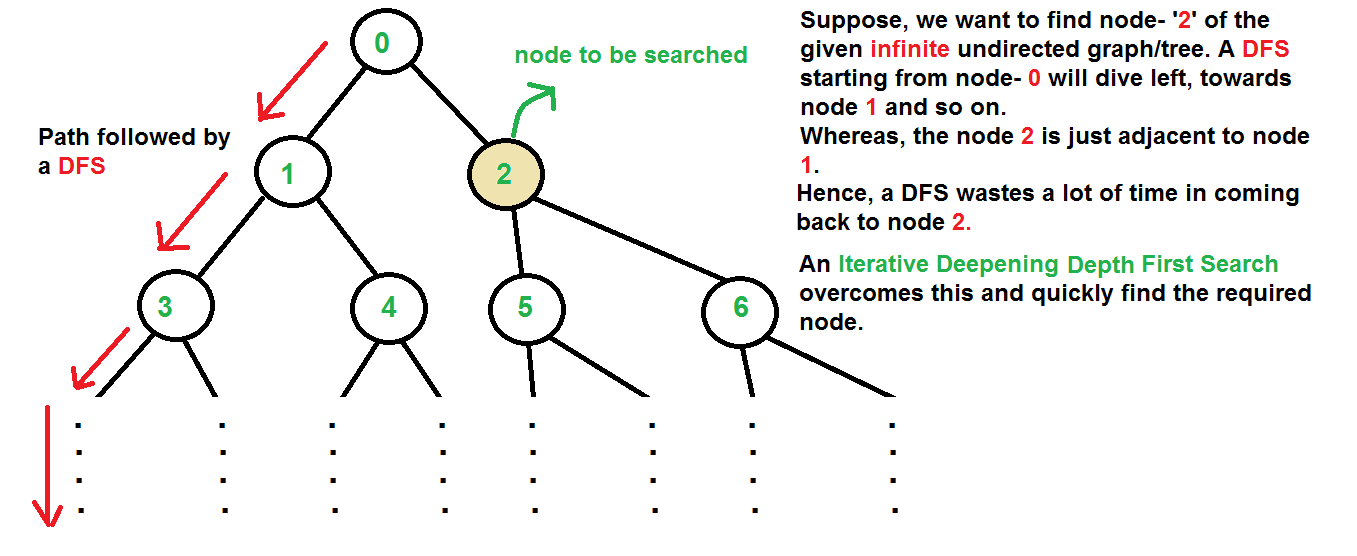
2.
BFS
goes level by level, but requires more space. The space required
by DFS is O(d) where d is depth of tree,
but space required by BFS is O(n) where n is number of nodes in
tree (Why? Note that the last level of tree can have around n/2 nodes and
second last level n/4 nodes and in
BFS we need to have every level one by one in queue).
IDDFS combines depth-first search’s space-efficiency and breadth-first search’s
fast search (for nodes closer to root).
How does IDDFS work?
IDDFS calls DFS for different depths starting from an initial value. In every call, DFS is restricted from going beyond given
depth. So basically we do DFS in a BFS fashion.
Algorithm:
// Returns
true if target
is reachable from
// src within max_depth
bool IDDFS(src,
target, max_depth)
for limit from 0 to max_depth
if DLS(src, target,
limit) == true
return true
return false
bool DLS(src, target,
limit)
if (src == target)
return true;
// If reached the maximum depth,
// stop recursing.
if (limit <= 0)
return false;
foreach adjacent i of src
if DLS(i, target,
limit?1)
return true
return false
An important thing to note is, we visit top level nodes
multiple times. The last (or max depth) level is visited once, second last
level is visited twice, and so on. It may seem
expensive, but it turns out to be not so costly,
since in a tree most of the nodes are in the bottom level. So it does
not matter much if the upper levels are visited multiple times.
Planning
Blocks World
Problem
In order to compare the variety of methods of planning, we should find it useful to look at all of
them in a single domain that is complex enough that the need for each of the
mechanisms is apparent yet simple enough that easy-to-follow examples can be
found.
·
There
is a flat surface on which
blocks can be placed.
·
There
are a number of square blocks, all the same size.
·
They
can be stacked one upon the other.
·
There
is robot arm that can
manipulate the blocks.
Actions of the robot
arm
1.
UNSTACK(A, B): Pick up block A from its current position
on block B.
2. STACK(A, B): Place block A on block B.
3. PICKUP(A): Pick up
block A from the table and hold
it.
4.
PUTDOWN(A): Put block
A down on the table. Notice that the robot arm can hold only one block at a time. Predicates
·
In
order to specify
both the conditions under which an operation may be performed
and the results of performing it, we need the following predicates:
1.
ON(A,
B): Block A is on Block
B.
2.
ONTABLES(A): Block A is on the table.
3.
CLEAR(A): There is nothing on the
top of Block A.
4.
HOLDING(A): The arm is holding Block
A.
5.
ARMEMPTY: The arm is holding nothing.
Robot problem-solving systems (STRIPS)
·
List
of new predicates that the operator causes to become true is ADD List
·
Moreover, List of old predicates that the operator causes to become false is DELETE
List
·
PRECONDITIONS list contains those predicates that must be true for the operator
to be applied.
STRIPS style operators
for BLOCKs World
STACK(x, y)
P: CLEAR(y)^HOLDING(x) D: CLEAR(y)^HOLDING(x) A: ARMEMPTY^ON(x, y) UNSTACK(x, y)
PICKUP(x)
P: CLEAR(x) ^ ONTABLE(x) ^ARMEMPTY D: ONTABLE(x) ^ ARMEMPTY
A: HOLDING(x) PUTDOWN(x)
Goal Stack Planning
To start with goal stack is simply:
·
ON(C,A)^ON(B,D)^ONTABLE(A)^ONTABLE(D)
This problem
is separate into four
sub-problems, one for each component of the goal.
Two of the sub-problems ONTABLE(A) and ONTABLE(D) are already true in the initial
state.

Alternative 1: Goal Stack:
·
ON(C,A)
·
ON(B,D)
·
ON(C,A)^ON(B,D)^OTAD
Alternative 2: Goal stack:
·
ON(B,D)
·
ON(C,A)
·
ON(C,A)^ON(B,D)^OTAD
Exploring Operators
·
Pursuing alternative 1, we check for operators
that could cause ON(C, A)
·
Out
of the 4 operators, there is only one STACK.
So it yields:
·
STACK(C,A)
·
ON(B,D)
·
ON(C,A)^ON(B,D)^OTAD
·
Preconditions for STACK(C, A) should
be satisfied, we must establish
them as sub-goals:
·
CLEAR(A)
·
HOLDING(C)
·
CLEAR(A)^HOLDING(C)
·
STACK(C,A) o ON(B,D)
·
ON(C,A)^ON(B,D)^OTAD
·
Here
we exploit the Heuristic that if HOLDING
is one of the several
goals to be achieved
at once, it should be tackled last.
Goal stack Planning
·
Next,
we see if CLEAR(A) is true.
It is not. The only operator that could make it true is
UNSTACK(B, A). Also, This produces the goal stack:
·
ON(B,
A)
·
CLEAR(B)
·
ON(B,A)^CLEAR(B)^ARMEMPTY
·
UNSTACK(B, A)
·
HOLDING(C)
·
CLEAR(A)^HOLDING(C)
·
STACK(C,A)
·
ON(B,D)
·
ON(C,A)^ON(B,D)^OTAD
·
We see that we can pop predicates on the stack till we reach HOLDING(C) for which we need to find a suitable operator.
·
 |
Moreover, The operators that might make HOLDING(C) true: PICKUP(C) and UNSTACK(C, x). Without looking ahead, since we cannot tell which of these operators is appropriate. Also, we create two branches of the search tree corresponding to the following goal stacks:
Complete plan
1.
UNSTACK(C, A)
2. PUTDOWN(C )
3. PICKUP(A)
4. STACK(A, B)
5. UNSTACK(A, B)
6. PUTDOWN(A)
7. PICKUP(B)
8. STACK(B, C)
9. PICKUP(A)
10. STACK(A,B)
Planning Components
·
Methods which focus on ways of
decomposing the original problem into appropriate subparts and on ways of recording
and handling interactions among the subparts
as they are detected during
the problem-solving process are often called as planning.
·
Planning refers to the process of computing several
steps of a problem-solving procedure before executing any of them.
Components of a planning system
Choose the
best rule to apply next, based on the best available
heuristic information.
·
The
most widely used technique for selecting appropriate rules to apply is first to isolate a set of differences between
desired goal state and then to identify those rules that are relevant to reduce
those differences.
·
If there are several rules,
a variety of other heuristic information can be exploited to choose among them.
Apply the chosen rule to compute the
new problem state that arises from its application.
·
In
simple systems, applying
rules is easy.
Each rule simply
specifies the problem
state that would result from its application.
·
In
complex systems, we must be able to deal with rules that specify only a small part of the complete problem state.
·
One
way is to describe, for each action,
each of the changes it makes
to the state description.
Detect when a solution
has found.
·
A planning system
has succeeded in finding a solution to a problem
when it has found a sequence of operators that transform
the initial problem state into the goal state.
·
How
will it know when this has done?
·
In
simple problem-solving systems,
this question is easily answered
by a straightforward match of the state descriptions.
·
One
of the representative systems for planning systems
is predicate logic.
Suppose that as a part of our goal, we have the
predicate P(x).
·
To
see whether P(x) satisfied in some state,
we ask whether we can prove P(x) given the assertions that describe that state
and the axioms that define the world model.
Detect dead ends so that they can abandon and the system’s
effort directed in more fruitful directions.
·
As a planning system is searching for
a sequence of operators to solve a particular problem, it must be able to detect when it is exploring a path that can never lead to a
solution.
·
The
same reasoning mechanisms that can use to detect
a solution can often use for
detecting a dead end.
·
If the search
process is reasoning forward from the initial state.
It can prune any path that
leads to a state from which the goal state cannot reach.
·
If search process reasoning backward
from the goal state, it can also terminate a path either because it is sure that the initial
state cannot reach
or because little
progress made.
Detect when an almost correct
solution has found and employ
special techniques to make it totally correct.
·
The
kinds of techniques discussed are often
useful in solving
nearly decomposable problems.
·
One good way of solving such problems
is to assume that they are completely decomposable, proceed to solve the sub-problems separately. And then check that when
the sub-solutions combined. They do in fact give a solution to the original
problem.
Goal Stack Planning
·
Methods which focus on ways of
decomposing the original problem into appropriate subparts and on ways of recording. And handling interactions among the subparts
as they are detected during
the problem-solving process are often called as planning.
·
Planning refers to the process of computing several
steps of a problem-solving procedure before executing any of them.
·
Goal Stack Planning Method
·
In
this method, the problem solver
makes use of a single
stack that contains
both goals and operators.
That have proposed to satisfy those goals.
·
The
problem solver also relies on a database
that describes the current situation and a set of operators described as
PRECONDITION, ADD and DELETE lists.
·
The
goal stack planning
method attacks problems
involving conjoined goals by solving the goals one at a time, in order.
·
A plan generated by this method
contains a sequence
of operators for attaining the first
goal, followed by a complete sequence for the second goal etc.
·
At
each succeeding step of the problem-solving process,
the top goal on the stack will pursue.
·
When
a sequence of operators that satisfies it, found, that sequence applied
to the state description, yielding new description.
·
Next,
the goal that then at the top of the stack explored. And an attempt
made to satisfy
it, starting from the situation that produced as a result of satisfying
the first goal.
·
This
process continues until
the goal stack
is empty.
·
Then
as one last check, the original goal compared to the final state derived
from the application of the
chosen operators.
·
If any components of the goal not satisfied in that state.
Then those unsolved
parts of the goal reinserted onto the stack and the
process resumed.
Nonlinear Planning using Constraint Posting
·
Difficult problems cause goal interactions.
·
The
operators used to solve one sub-problem may interfere with the solution
to a previous sub-problem.
·
Most
problems require an intertwined plan in which multiple sub-problems worked on simultaneously.
·
Such
a plan is called nonlinear plan because it is not composed of a linear
sequence of complete
sub-plans.
Constraint Posting
·
The idea of constraint posting is to
build up a plan by incrementally hypothesizing operators, partial
orderings between operators, and binding of variables within operators.
·
At
any given time in the problem-solving process, we may have a set of useful operators but perhaps no clear
idea of how those operators
should order with respect to each other.
·
A solution is a partially
ordered, partially instantiated set of operators to generate an actual plan. And we convert the partial
order into any number of total orders.
Constraint Posting versus
State Space search
State Space Search
·
Moves in the space: Modify world
state via operator
·
Model
of time: Depth of node
in search space
·
Plan
stored in Series
of state transitions Constraint Posting Search
·
Moves
in the space: Add operators, Oder Operators, Bind variables Or Otherwise
constrain plan
·
Model
of Time: Partially ordered
set of operators
·
Plan
stored in Single node
Algorithm: Nonlinear Planning
(TWEAK)
1.
Initialize S to be the set of
propositions in the goal state.
2. Remove some unachieved proposition P from S.
3.
Moreover, Achieve P by using step addition, promotion, DE clobbering, simple establishment or separation.
4.
Review all the steps in the plan, including
any new steps introduced by step addition,
to see if any of their preconditions unachieved. Add to S the new set of
unachieved preconditions.
5.
Also, If S is empty, complete the plan by converting the partial order of steps into a total
order, instantiate any variables as necessary.
6. Otherwise, go to step 2.
Hierarchical Planning
·
In
order to solve hard problems, a problem solver
may have to generate
long plans.
·
It
is important to be able to eliminate some of the details of the problem
until a solution that addresses the main issues
is found.
·
Then
an attempt can make to fill in the appropriate details.
·
Early
attempts to do this involved
the use of macro operators, in which larger
operators were built from smaller ones.
·
In
this approach, no details eliminated from actual descriptions of the operators.
ABSTRIPS
A better approach
developed in ABSTRIPS
systems which actually
planned in a hierarchy of abstraction spaces, in each of which
preconditions at a lower level of abstraction ignored.
ABSTRIPS approach
is as follows:
·
First
solve the problem
completely, considering only preconditions whose criticality
value is the highest possible.
·
These
values reflect the expected
difficulty of satisfying the precondition.
·
To
do this, do exactly what STRIPS did, but simply
ignore the preconditions of lower than peak
criticality.
·
Once
this done, use the constructed plan as the outline of a complete
plan and consider preconditions at the next-lowest
criticality level.
·
Augment the plan with operators that
satisfy those preconditions.
·
Because this approach explores
entire plans at one level of detail
before it looks
at the lower-level details of
any one of them, it has called length-first approach.
The assignment of appropriate criticality value is crucial
to the success of this hierarchical
planning method.
Those preconditions that no operator can satisfy are clearly the most
critical.
Example, solving a problem of moving the robot, for
applying an operator, PUSH-THROUGH DOOR, the precondition that there exist
a door big enough for the robot to get through is of high criticality since there is nothing
we can do about it if it is not true.
Other Planning
Techniques
Reactive Systems
·
The
idea of reactive
systems is to avoid planning
altogether, and instead,
use the observable situation
as a clue to which one can simply react.
·
A reactive system
must have access
to a knowledge base of some sort that describes what actions should be taken under what circumstances.
·
A reactive system
is very different
from the other kinds of planning systems
we have discussed. Because it
chooses actions one at a time.
·
It
does not anticipate and select an entire action
sequence before it does the first thing.
·
The
example is a Thermostat. The job of the thermostat is to keep the temperature constant inside a room.
·
Reactive systems are capable of surprisingly complex
behaviors.
·
The
main advantage reactive
systems have over traditional planners
is that they operate
robustly in domains that are difficult to model completely and accurately.
·
Reactive systems dispense with modeling altogether and base their actions directly
on their perception of the world.
·
Another advantage of reactive
systems is that they are extremely responsive since they avoid the
combinatorial explosion involved in deliberative planning.
·
This
makes them attractive for real-time
tasks such as driving and walking.
Other Planning Techniques
Triangle tables
·
Provides a way of recording the goals that each operator expected to satisfy as well as the
goals that must be true for it to execute correctly.
Meta-planning
·
A technique for reasoning not just about
the problem solved
but also about
the planning process itself.
Macro-operators
·
Allow
a planner to build new operators that represent commonly
used sequences of operators.
Case-based planning:
·
Re-uses old plans to make
new ones.
UNDERSTANDING
Understanding
is the simplest procedure of all human beings. Understanding means ability to
determine some new knowledge from a given knowledge. For each action of a
problem, the mapping of some new actions is very necessary. Mapping the knowledge means transferring the
knowledge from one representation to another representation. For example, if
you will say “I need to go to New Delhi” for which you will book the tickets.
The system will have “understood” if it finds the first available plane to New
Delhi. But if you will say the same
thing to you friends, who knows that your family lives in “New Delhi”, he/she will have “understood” if he/she
realizes that there may be a problem or occasion in your family. For people,
understanding applies to inputs from all the senses. Computer understanding has
so far been applied primarily to
images, speech and typed languages. It is important to keep in mind that the
success or failure of an “understanding” problem
can rarely be measured in an absolute
sense but must instead be
measured with respect to a particular task to be performed. There are some
factors that contribute to the difficulty of an understanding problem.
(a) If the target representation is very complex
for which you cannot map from the original
representation.
(b) There are different types
of mapping factors
may arise like one-to-one, one-to-many and many to many.
(c) Some noise or
disturbing factors are also there.
(d) The level of interaction of the source components may be complex
one.
(e) The problem
solver might be unknown about some more complex problems.
(f) The intermediary actions may also be
unavailable.
Consider an
example of an English sentence which is being used for communication with a
keyword based data retrieval system.
Suppose I want to know all about the
temples in India. So I would need to be translated into a representation such as The above sentence
is a simple sentence for
which the corresponding representation may be
easy to implement. But what for the
complex queries?
Consider
the following query.
“Ram told
Sita he would not eat apple with her. He has to go
to the office”.
This type of
complex queries can be modeled with the conceptual dependency representation
which is more complex than that of simple representation. Constructing these
queries is very difficult since more informationare to be extracted. Extracting
more information will require some more knowledge. Also the type of mapping
process is not quite easy to the problem solver. Understanding is the process of
mapping an input from its original form to a more useful one.
The simplest
kind of mapping is “one-toone”.
In one-to-one
mapping each different problems would lead to only one solution. But there are
very few inputs which are one-to-one. Other
mappings are quite difficult to implement. Many-to- one mappings are frequent is
that free variation is often allowed, either because of the physical
limitations of that produces the inputs or because such variation simply makes
the task of generating the inputs.
Many to one mapping
require that the understanding system
know about all the ways that a target
representation can be expressed in the source language. One-to-many mapping
requires a great deal of domain knowledge in order to make the correct choice
among the available target representation.
The mapping
process is simplest
if each component can be mapped
without concern for the other
components of the statement. If the number of interactions increases, then the
complexity of the problem will
increase. In many understanding situations the input to which meaning should be
assigned is not always the input that is presented to the under stander.
Because of
the complex environment in which understanding usually occurs, other things
often interfere with the basic input
before it reaches
the under stander.
Hence the understanding will be more complex
if there will be some sort of noise on the inputs.
Natural Language Processing
Introduction to Natural Language
Processing
·
Language meant for communicating with the world.
·
Also,
By studying language, we can come to
understand more about the world.
·
If we can succeed at building computational mode of language, we will have a powerful tool for communicating with the
world.
·
Also,
We look at how we can exploit
knowledge about the world, in combination with linguistic facts, to build
computational natural language systems.
Natural Language
Processing (NLP) problem
can divide into two tasks:
1.
Processing written text, using lexical, syntactic
and semantic knowledge
of the language as well as the required real-world information.
2.
Processing spoken language, using all
the information needed above plus additional knowledge about phonology as well as enough added information to handle the further
ambiguities that arise in speech.
Steps in Natural
Language Processing
Morphological
Analysis
·
Individual words analyzed into their components and non-word tokens such as punctuation separated from the words.
Syntactic Analysis
·
Linear sequences of words transformed into structures that show how the words relate to each other.
·
Moreover, Some word sequences may reject if they violate
the language’s rule for
how words may combine.
Semantic Analysis
·
The
structures created by the syntactic analyzer assigned meanings.
·
Also,
A mapping made between the syntactic structures and objects in the task domain.
·
Moreover, Structures for which
no such mapping
possible may reject. Discourse integration
·
The
meaning of an individual sentence
may depend on the sentences that precede it. And
also, may influence the meanings of the sentences that follow it.
Pragmatic Analysis
·
Moreover, The structure representing what said reinterpreted to determine what was
actually meant.
Summary
·
Results of each of the main processes
combine to form a natural
language system.
·
All
of the processes are important in a complete natural language understanding system.
·
Not
all programs are written with exactly
these components.
·
Sometimes two or more of them
collapsed.
·
Doing
that usually results
in a system that is easier to build for restricted subsets
of English but one that is harder to extend to wider coverage.
Steps Natural Language Processing
Morphological Analysis
·
Suppose we have an English interface to an operating system and the following sentence typed: I want to print Bill’s
.init file.
·
The
morphological analysis must do the following things:
·
Pull
apart the word “Bill’s” into proper
noun “Bill” and the possessive suffix “’s”
·
Recognize the sequence “.init”
as a file extension that is functioning as an adjective in the sentence.
·
This
process will usually
assign syntactic categories to all the words in the
sentence.
Syntactic Analysis
·
A syntactic analysis
must exploit the results of the morphological analysis to build a
structural description of the sentence.
·
The
goal of this process, called
parsing, is to convert the flat list of words
that form the sentence into a structure that
defines the units that represented by that flat list.
·
The important thing here is that a
flat sentence has been converted into a hierarchical structure. And that the structure corresponds to meaning units when a semantic analysis performed.
·
Reference markers (set of entities)
shown in the parenthesis in the
parse tree.
·
Each
one corresponds to some entity that has
mentioned in the sentence.
·
These
reference markers are useful later
since they provide
a place in which to accumulate information about the
entities as we get it.

Semantic Analysis
·
The
semantic analysis must do
two important things:
1.
It
must map individual words into appropriate objects in the knowledge base or
database.
2.
It
must create the correct structures to correspond to the way the meanings
of the individual words
combine with each other.
Discourse Integration
·
Specifically, we do not know whom the pronoun “I” or the proper noun “Bill” refers to.
·
To pin down these references requires
an appeal to a model of the current discourse context, from which we can learn
that the current
user is USER068
and that the only
person named “Bill” about whom we could be talking is USER073.
·
Once
the correct referent
for Bill known,
we can also determine exactly
which file referred to.
Pragmatic Analysis
·
The
final step toward effective understanding is to decide what to do as a
result.
·
One
possible thing to do to record
what was said as a fact and done with
it.
·
For
some sentences, a whose intended
effect is clearly
declarative, that is the precisely correct thing to do.
·
But
for other sentences, including this one,
the intended effect is different.
·
We can discover
this intended effect
by applying a set of rules that characterize
cooperative dialogues.
·
The
final step in pragmatic processing to translate, from the knowledge-based representation to a
command to be executed by the system.
Syntactic Processing
·
Syntactic Processing is the step in
which a flat input sentence converted into a hierarchical structure
that corresponds to the units of meaning
in the sentence. This
process called parsing.
·
It
plays an important role in
natural language understanding systems for two reasons:
1.
Semantic processing must operate
on sentence constituents. If there is no syntactic parsing step, then the semantics
system must decide on its own constituents. If parsing is done, on the other
hand, it constrains the number of constituents that semantics can consider.
2.
Syntactic parsing is computationally less expensive than is semantic
processing. Thus it can play a significant role in reducing overall
system complexity.
·
Although it is often
possible to extract
the meaning of a sentence
without using grammatical
facts, it is not always possible to do so.
·
Almost all the systems that are actually used have two main components:
1.
A declarative representation, called a grammar,
of the syntactic facts about the
language.
2.
A procedure, called parser that compares the grammar against
input sentences to produce parsed structures.
Grammars and Parsers
·
The
most common way to represent
grammars is a set of production rules.
·
The
first rule can read as “A sentence
composed of a noun phrase
followed by Verb Phrase”; the Vertical bar is OR; ε
represents the empty string.
·
Symbols that further
expanded by rules called non-terminal symbols.
·
Symbols that correspond directly
to strings that must found in an input sentence
called terminal symbols.
·
Grammar formalism such as this one underlies
many linguistic theories, which in turn provide the basis for many natural
language understanding systems.
·
Pure
context-free grammars are not effective
for describing natural languages.
·
NLPs
have less in common with computer language
processing systems such as
compilers.
·
Parsing process takes the rules of the grammar
and compares them against the input
sentence.
·
The
simplest structure to build is a Parse Tree, which
simply records the rules and how
they matched.
·
Every
node of the parse tree corresponds either
to an input word or to a non-terminal in our grammar.
·
Each
level in the parse tree corresponds to the application of one grammar rule.
Example for Syntactic
Processing – Augmented Transition Network
Syntactic Processing is the step in which a flat input
sentence is converted into a hierarchical structure that corresponds to the units of meaning
in the sentence. This process
called parsing. It plays an
important role in natural language understanding systems for two reasons:
1.
Semantic processing must operate on
sentence constituents. If there is no syntactic parsing step, then the semantics system
must decide on its own constituents. If parsing is done, on the other hand, it constrains
the number of constituents that semantics can consider.
2.
Syntactic parsing is computationally less expensive than is semantic
processing. Thus it can play a significant role in
reducing overall system complexity.
Example: A Parse tree for a sentence: Bill Printed the file

The grammar specifies two things about
a language:
1.
Its weak generative capacity, by which
we mean the set of sentences that contained within the language. This set made up of precisely those sentences that can completely match by a series of rules in
the grammar.
2.
Its
strong generative capacity,
by which we mean the structure to assign to each
grammatical sentence of the language.
Augmented Transition Network
(ATN)
·
An augmented transition network is a
top-down parsing procedure that allows various kinds of knowledge to incorporated into the parsing
system so it can operate
efficiently.
·
ATNs
build on the idea of using finite state machines (Markov model)
to parse sentences.
·
Instead of building an automaton for a particular sentence, a collection of transition graphs
built.
·
A grammatically correct sentence parsed by reaching a final
state in any state graph.
·
Transitions between these graphs
simply subroutine calls from one state to any initial state on any graph in the network.
·
A sentence determined to be grammatically correct if a final state
reached by the last
word in the sentence.
·
The
ATN is similar to a finite state machine in which the class of labels that can attach to the arcs that define the
transition between states has augmented.
Arcs may label with:
·
Specific words such as
“in’.
·
Word
categories such as noun.
·
Procedures that build structures that will form part of the final
parse.
·
Procedures that perform arbitrary
tests on current
input and sentence
components that have
identified.
Semantic Analysis
·
The
structures created by the syntactic analyzer assigned meanings.
·
A mapping made between the syntactic structures and objects in the task
domain.
·
Structures for which no such
mapping is possible may rejected.
·
The
semantic analysis must do
two important things:
·
It must map individual words into appropriate objects in the knowledge base or
database.
·
It
must create the correct structures to correspond to the way the meanings
of the individual words
combine with each other. Semantic Analysis AI
·
Producing a syntactic parse of a sentence is only
the first step toward
understanding it.
·
We must
produce a representation of the meaning
of the sentence.
·
Because understanding is a mapping process,
we must first
define the language
into which we are trying to map.
·
There
is no single definitive language
in which all sentence
meaning can describe.
·
The
choice of a target language
for any particular natural language understanding program must depend on what
is to do with the meanings once they constructed.
·
Choice of the target
language in Semantic Analysis AI
·
There are two broad families of target
languages that used in NL systems, depending
on the role that the natural language
system playing in a larger
system:
·
When natural language considered as a
phenomenon on its own, as for example when one builds a program whose goal is
to read the text and then answer questions about it. A target language can design specifically to support language processing.
·
When
natural language used as an interface language
to another program
(such as a db query system or an expert system), then the
target language must legal input to that other program. Thus the design of the
target language driven by the backend program.
Discourse
and Pragmatic Processing
To understand a single sentence, it is necessary to consider the discourse and pragmatic context in which the sentence was
uttered.
There are a number of important relationships that may hold between phrases
and parts of their
discourse contexts, including:
1. Identical entities.
Consider the text:
·
Bill
had a red balloon. o John wanted it.
·
The
word “it” should
identify as referring
to the red balloon. These types of references called anaphora.
2. Parts of entities. Consider the text:
·
Sue
opened the book she just bought.
·
The
title page was torn.
·
The
phrase “title page” should be recognized as part of the book that was just
bought.
3. Parts of actions. Consider
the text:
·
John
went on a business
trip to New York.
·
He left
on an early morning flight.
·
Taking a flight should recognize as part of going on a trip.
4. Entities involved
in actions. Consider the text:
·
My
house was broken into last week.
·
Moreover, They took the TV and the stereo.
·
The
pronoun “they” should
recognize as referring
to the burglars who broke into
the house.
5. Elements of sets.
Consider the text:
·
The
decals we have in stock are stars, the moon, item
and a flag.
·
I’ll
take two moons.
·
Moons
mean moon decals.
6. Names of
individuals:
·
Dev
went to the movies.
7. Causal chains
·
There
was a big snow storm yesterday.
·
So,
The schools closed today.
8. Planning sequences:
·
Sally
wanted a new car
·
She
decided to get a job.
9. Implicit presuppositions:
·
Did Joe fail CS101?
The major focus is on using following kinds of knowledge:
·
The
current focus of the dialogue.
·
Also,
A model of each participant’s current beliefs.
·
Moreover, The goal-driven character of dialogue.
·
The
rules of conversation shared by all participants.
Statistical Natural
Language Processing
Formerly, many language-processing tasks typically
involved the direct hand coding of rules, which is not in general robust to natural-language variation. The machine-learning
paradigm calls instead
for using statistical inference to automatically learn such rules
through the analysis of large
corpora of typical real-world examples (a corpus (plural, "corpora") is a set of documents,
possibly with human or computer annotations).
Many different classes of machine learning algorithms
have been applied to natural-language processing tasks. These algorithms take as input a large
set of "features" that are generated from the
input data. Some of the earliest-used algorithms, such as decision trees, produced systems of hard
if-then rules similar to the systems of hand-written rules that were then
common.
Increasingly, however,
research has focused
on statistical models, which make
soft, probabilistic
decisions based on attaching real-valued
weights to each input feature. Such models have the advantage that
they can express the relative certainty of many
different possible answers rather than only one, producing more reliable results
when such a model is included as a
component of a larger system.
Systems based
on machine-learning algorithms have many advantages over hand-produced rules:
·
The
learning procedures used during machine
learning automatically focus on the most
common cases, whereas when writing rules
by hand it is often not at all
obvious where the effort should be directed.
·
Automatic learning procedures can make
use of statistical inference algorithms to produce models that are robust to
unfamiliar input (e.g. containing words or structures that have not been seen
before) and to erroneous input (e.g. with misspelled words or words accidentally omitted). Generally, handling
such input gracefully with hand-written
rules—or more generally, creating systems of hand-written rules that make soft
decisions—is extremely difficult, error-prone and time-consuming.
·
Systems based on automatically
learning the rules can be made more accurate simply by supplying more input
data. However, systems based on hand-written rules can only be made more
accurate by increasing the complexity of the rules, which is a much more difficult
task. In particular, there is a limit to the complexity of systems based on
hand- crafted rules, beyond which the systems become more and more
unmanageable. However, creating more data to input to machine-learning systems
simply requires a corresponding increase in the number
of man-hours worked,
generally without significant increases in the complexity of
the annotation process.
Spell Checking
Spell checking
is one of the applications of natural language processing that impacts billions
of users daily. A good introduction to spell checking
can be found on Peter
Norvig’s webpage. The article introduces a simple 21-line
spell checker implementation in Python combining simple language and error
models to predict the word a user intended to type. The language model estimates how likely a given word `c` is in the
language for which the spell checker is designed, this can be written as
`P(C)`. The error model estimates the probability `P(w|c)` of typing the
misspelled version `w` conditionally to the intention of typing the correctly
spelled word `c`.The spell checker then returns word `c` corresponding to
the highest value of
`P(w|c)P(c)` among all possible
words in the language.
Module 3
LEARNING
Learning is the improvement of performance with experience over time.
Learning element is the portion
of a learning AI system that decides
how to modify the performance element and implements
those modifications.
We all learn new knowledge through different methods,
depending on the type of material to be learned, the amount of relevant knowledge we already possess,
and the environment in which the learning takes place. There are five
methods of learning . They are,
1.
Memorization (rote learning)
2. Direct instruction (by being told)
3. Analogy
4. Induction
5.
Deduction
Learning by memorizations is the simplest from of
le4arning. It requires the least amount of inference and is accomplished by simply copying
the knowledge in the same form that it will be
used directly into the knowledge base.
Example:- Memorizing multiplication tables, formulate , etc.
Direct instruction is a complex form of learning. This
type of learning requires more inference than role learning since the knowledge
must be transformed into an operational form before learning when a teacher
presents a number of facts directly to us in a well organized manner.
Analogical learning is the process of learning a new concept or solution
through the use of similar known concepts or solutions. We use this type of
learning when solving problems on an exam where previously learned examples serve
as a guide or when make frequent use of analogical learning. This form of learning requires
still more inferring than either of the previous
forms. Since difficult transformations must be made between the known and unknown situations. Learning by induction is also
one that is used frequently by humans . it is a powerful form of learning like
analogical learning which also require s more inferring than the first two
methods. This learning re quires the use of inductive inference, a form of
invalid but useful inference. We use inductive learning ofinstances of examples
of the concept. For example we learn the concepts
of color or sweet taste after experiencing the sensations associated with
several examples of colored objects or sweet foods.
Deductive learning is accomplished through a sequence of
deductive inference steps using known facts. From the known facts, new facts or relationships are logically derived.
Deductive learning usually requires more inference than the other
methods.
Review Questions:-
1. what is perception ?
2.
How
do we overcome the Perceptual
Problems?
3. Explain in detail the constraint satisfaction waltz algorithm?
4. What is learning ?
5. What is Learning element
?
6. List and explain the methods of learning?
Types of learning:- Classification or taxonomy of learning types serves as a guide in studying or comparing a differences among them. One can develop
learning taxonomies based
on the type of knowledge
representation used (predicate calculus , rules, frames), the type of knowledge
learned (concepts, game playing, problem solving), or by the area of
application(medical diagnosis , scheduling , prediction and so on).
The classification is intuitively more appealing and is
one which has become popular among machine learning researchers . it is independent of the
knowledge domain and the representation scheme is used. It is based
on the type of inference strategy employed or the methods
used in the learning process. The five different
learning methods under this taxonomy are:
Memorization (rote learning) Direct instruction(by being told) Analogy
Induction Deduction
Learning by memorization is the simplest form of
learning. It requires the least5 amount of inference and is accomplished by simply copying
the knowledge in the same form that it will be
used directly into the knowledge
base. We use this type of learning
when we memorize multiplication tables ,
for example.
A slightly more complex form of learning
is by direct instruction. This type of learning requires more understanding and inference
than role learning since the knowledge must be transformed into an operational
form before being integrated into the knowledge base. We use this type of
learning when a teacher presents a number of facts directly to us in a well
organized manner.
The third type listed, analogical learning, is the
process of learning an ew concept or solution through the use of similar known
concepts or solutions. We use this type of learning when solving problems on an
examination where previously learned examples serve as a guide or when we learn
to drive a truck using our knowledge of car driving. We make frewuence use of
analogical learning. This form of learning requires
still more inferring than either of the previous forms, since difficult transformations must be made between the known and unknown situations. This is a kind of application
of knowledge in a new situation.
The fourth type of learning
is also one that is used frequency by humans. It is a powerful
form of learning which, like
analogical learning, also requires more inferring than the first two methods.
This form of learning requires the use of inductive inference, a form of
invalid but useful inference. We use inductive learning when wed formulate a general
concept after seeing a number of instance or examples of the concept. For
example, we learn the concepts of color sweet taste after experiencing the
sensation associated with several examples of colored objects or sweet foods.
The final type of acquisition is deductive learning. It
is accomplished through a sequence of deductive inference steps using known
facts. From the known facts, new facts or relationships are logically
derived. Deductive learning
usually requires more inference than the other
methods. The inference method used is, of course , a deductive type,
which is a valid from of inference.
In addition to the above classification, we will
sometimes refer to learning methods as wither methods or knowledge-rich
methods. Weak methods are general purpose methods
in which little or no initial knowledge is available. These methods are more
mechanical than the classical AI knowledge – rich methods. They often rely on a form of heuristics search in the learning process.
Rote Learning
Rote learning is the basic learning activity. Rote learning
is a memorization technique based
on repetition. It is also called memorization because the knowledge, without
any modification is, simply copied into the knowledge base. As computed
values are stored,
this technique can save a significant amount of time.
Rote
learning technique can also be used in complex learning systems provided
sophisticated techniques are employed
to use the stored values
faster and there
is a generalization to keep the
number of stored information down to a manageable level. Checkers-playing
program, for ex
The idea is
that one will be able to quickly recall the meaning of the material the more
one repeats it. Some of the alternatives to rote learning include meaningful
learning, associative learning, and active
learning. ample, uses this technique to learn the board positions
it evaluates in its
look-ahead search.
Learning By Taking
Advice.
This is a simple form of learning.
Suppose a programmer writes a set of instructions to instruct the
computer what to do, the programmer is a teacher and the computer is a student.
Once learned (i.e. programmed), the system will be in a position to do new
things.
The advice may come from many sources: human experts,
internet to name a few. This type of learning
requires more inference
than rote learning. The knowledge must be transformed into an operational
form before stored in the knowledge base. Moreover the reliability of the source of knowledge should be
considered.
The system should ensure that the new knowledge is
conflicting with the existing knowledge. FOO
(First Operational Operationaliser), for example, is a learning
system which is used to learn
the game of Hearts. It converts the advice which is in the form of principles,
problems, and methods into effective executable (LISP) procedures (or
knowledge). Now this knowledge is ready to use.
General Learning
Model.
General Learning Model: - AS noted earlier, learning can
be accomplished using a number of different methods, such as by memorization
facts, by being told, or by studying examples like problem solution. Learning requires that new knowledge structures be created
from some form of
input stimulus. This new knowledge must then be assimilated into a knowledge
base and be tested in some way for its utility. Testing means that the
knowledge should be used in performance of some task from which meaningful
feedback can be obtained, where the feedback provides some measure of the
accuracy and usefulness of the newly acquired knowledge.
General Learning
Model
 |
general learning model is depicted in figure 4.1 where
the environment has been included as a part of the overall learner system. The
environment may be regarded as either a form of nature which produces random
stimuli or as a more organized training source such as a teacher which provides
carefully selected training examples for the learner component. The actual form
of environment used will depend on the particular learning paradigm. In any
case, some representation language must be assumed for communication between
the environment and the learner. The language
may be the same representation scheme as that used in the knowledge base (such as a form of predicate calculus). When they are
hosen to be the same, we say the single representation trick is being used.
This usually results in a simpler
implementation since it is not necessary to transform between two or more
different representations.
For some systems
the environment may be a user working
at a keyboard . Other systems will use
program modules to simulate a particular environment. In even more realistic
cases the system will have real physical sensors which interface with some
world environment.
Inputs to the learner component may be physical
stimuli of some type or descriptive , symbolic
training examples. The information conveyed to the learner component is used to
create and modify knowledge structures in the knowledge base. This same
knowledge is used by the performance component to carry out some tasks, such as solving a problem playing a game, or classifying instances of some
concept.
given a task, the performance component
produces a response describing its action in performing the task. The critic module
then evaluates this response relative
to an optimal response.
Feedback , indicating whether or not the performance was acceptable , is then sent by the critic module to the learner component for
its subsequent use in modifying the structures in the knowledge base. If proper
learning was accomplished, the system’s performance will have improved with the
changes made to the knowledge base.
The cycle described above may be repeated a number of
times until the performance of the system has reached
some acceptable level,
until a known learning goal has been reached, or until
changes ceases to occur in the knowledge base after some chosen number of
training examples have been observed.
There are several
important factors which influence a system’s ability
to learn in addition to the
form of representation used. They include the types of training provided, the form and extent of any initial background knowledge , the
type of feedback provided, and the learning algorithms used.
The type of training used in a system can have a strong effect
on performance, much the same as
it does for humans. Training may consist of randomly selected instance or
examples that have been carefully selected
and ordered for presentation. The instances may be positive examples of some concept or task a being learned,
they may be negative, or they may be mixture of both positive and negative. The
instances may be well focused using only relevant information, or they may
contain a variety of facts and details including irrelevant data.
There are Many forms of learning can be characterized as
a search through a space of possible hypotheses or solutions. To make learning
more efficient. It is necessary to constrain this search
process or reduce the search space. One method of achieving this is through the
use of background knowledge which can be used to constrain the search space or
exercise control operations which limit the search process.
Feedback is essential to the learner component since
otherwise it would never know if the knowledge structures in the knowledge base
were improving or if they were adequate for the performance of the given tasks. The feedback may be a simple yes or no type of evaluation,
or it
may contain more useful information describing why a
particular action was good or bad. Also , the
feedback may be completely reliable,
providing an accurate
assessment of the performance or it may
contain noise, that is the feedback
may actually be incorrect some of
the time. Intuitively , the feedback
must be accurate more than 50% of the time; otherwise the system carries useful
information, the learner should also to build up a useful corpus of knowledge
quickly. On the other hand, if the feedback is noisy or unreliable, the learning process may be very slow and the
resultant knowledge incorrect.
Learning Neural
Network
Perceptron
·
The
perceptron an invention of (1962) Rosenblatt was one of the earliest
neural network models.
·
Also,
It models a neuron by taking a weighted sum of its inputs and sending the output 1 if the sum is greater than some
adjustable threshold value (otherwise it sends 0).

Figure: A neuron
& a Perceptron

Figure: Perceptron with adjustable threshold
·
In case of zero
with two inputs g(x) =
w0 + w1x1 + w2x2 =
0
·
x2
= -(w1/w2)x1 – (w0/w2) → equation for a line
·
the
location of the line is determined by the weight w0 w1
and w2
·
if
an input vector lies on one side of the
line, the perceptron will
output 1
·
if
it lies on the other side,
the perception will output 0
·
Moreover, Decision surface: a line that correctly separates the training instances corresponds to a perfectly
function perceptron.
Perceptron Learning
Algorithm
Given: A classification problem with n input feature (x1, x2, …., xn) and
two output classes. Compute A set of weights
(w0, w1, w2,….,wn) that will cause a perceptron to fire whenever
the input falls into the
first output class.
1.
Create a perceptron with n+ 1 input
and n+ 1 weight, where the x0 is always set
to 1.
2.
Initialize the weights
(w0, w1,…., wn) to random real values.
3. Iterate through
the training set, collecting all examples
misclassified by the current
set of weights.
4.
If
all examples are classified correctly, output the weights
and quit.
5. Otherwise, compute
the vector sum S of the misclassified input vectors where each vector has the form (x0, x1, …, Xn). In creating the
sum, add to S a vector x if x is an
input for which the perceptron incorrectly fails to fire, but – x if x is
an input for which the perceptron incorrectly fires. Multiply sum by a scale
factor η.
6.
Moreover, Modify the weights (w0, w1, …, wn) by adding the elements
of the vector S to them.
7.
Go
to step 3.
·
The perceptron learning algorithm is a
search algorithm. It begins with a random initial state and finds a solution state.
The search space is simply
all possible assignments of real values to
the weights of the perception, and the search strategy is gradient descent.
·
The
perceptron learning rule is guaranteed to converge to a solution
in a finite number of steps, so long as a solution exists.
·
Moreover, This brings us to an
important question. What problems can a perceptron solve? Recall that a single-neuron perceptron is able to divide
the input space into two regions.
·
Also,
The perception can be used to classify
input vectors that can be separated by a
linear boundary. We call such vectors linearly separable.
·
Unfortunately, many problems are not linearly
separable. The classic
example is the XOR
gate. It was the inability of the basic perceptron to solve such simple
problems that are not linearly
separable or non-linear.
Genetic Learning
Supervised
Learning
Supervised learning is the machine
learning task of inferring a function from labeled training data.
Moreover, The training data consist of a set of training examples.
In supervised learning, each example a pair consisting of an input
object (typically a vector) and the desired output value (also called
the supervisory signal).
Training set
A training set a set of data used in various areas
of information science
to discover potentially predictive relationships.
Training sets used in artificial intelligence, machine learning, genetic programming, intelligent systems, and statistics.
In all these fields,
a training set has much the same role and often used in conjunction with a test set.
Testing set
A test set is
a set of data used in various
areas of information science to assess the strength
and utility of a predictive relationship.
Moreover, Test sets are used in artificial intelligence, machine learning, genetic programming,
and statistics. In all these fields, a test set has much the same role.
Accuracy of classifier: Supervised learning
In the fields of science, engineering, industry, and
statistics. The accuracy of a measurement system is the degree
of closeness of measurements of a quantity
to that quantity’s actual (true) value.
Sensitivity analysis: Supervised learning
Similarly, Local Sensitivity as correlation coefficients and partial derivatives can only use, if the correlation between input and output
is linear.
Regression: Supervised learning
In statistics, regression analysis
is a statistical process for estimating the relationships among variables.
Moreover, It includes
many techniques for modeling and analyzing several
variables. When the focus on the relationship between a dependent
variable and one or more independent variables. More specifically,
regression analysis helps one understand how the typical value of the dependent
variable (or ‘criterion variable’) changes when any one of the independent variables varied. Moreover, While the other independent variables held
fixed.
Expert systems:
Expert system = knowledge + problem-solving methods..... A knowledge base that captures
the domain-specific knowledge and an inference engine
that consists of algorithms for manipulating
the knowledge represented in the knowledge
base to solve a problem
presented to the system.
Expert systems (ES) are one of the prominent research
domains of AI. It is introduced by the
researchers at Stanford University, Computer Science Department.
What are Expert
Systems?
The expert systems
are the computer
applications developed to solve complex
problems in a particular domain, at the level of
extra-ordinary human intelligence and expertise.
Characteristics of Expert Systems
·
High
performance
·
Understandable
·
Reliable
·
Highly responsive
Capabilities of Expert Systems
The expert systems
are capable of −
·
Advising
·
Instructing and assisting human in decision
making
·
Demonstrating
·
Deriving a solution
·
Diagnosing
·
Explaining
·
Interpreting input
·
Predicting results
·
Justifying the conclusion
·
Suggesting alternative options to a problem They are incapable of −
·
Substituting human decision makers
·
Possessing human capabilities
·
Producing accurate output for inadequate knowledge base
·
Refining their own knowledge Components of Expert Systems
The components of ES include
−
·
Knowledge Base
·
Inference Engine
·
User
Interface
Let us see
them one by one briefly
−
 |
Knowledge Base
It contains domain-specific and high-quality knowledge.
Knowledge is required to exhibit intelligence.
The success of any ES majorly depends
upon the collection of highly accurate
and precise knowledge.
What is Knowledge?
The data is collection of facts. The information is
organized as data and facts about the task domain. Data, information, and past experience combined together are termed as knowledge.
Components of Knowledge Base
The knowledge base of an ES is a store of
both, factual and heuristic knowledge.
·
Factual Knowledge − It is the information widely
accepted by the Knowledge Engineers and scholars in the task domain.
·
Heuristic Knowledge − It is about practice, accurate
judgement, one’s ability
of evaluation, and guessing.
Knowledge representation
It is the method used to organize
and formalize the knowledge in the knowledge
base. It is in the
form of IF-THEN-ELSE rules.
Knowledge Acquisition
The success of any expert
system majorly depends
on the quality, completeness, and accuracy of the information stored in the knowledge
base.
The knowledge base is formed
by readings from various experts,
scholars, and the Knowledge Engineers. The knowledge
engineer is a person with the qualities of empathy, quick learning, and case
analyzing skills.
He acquires information from subject expert by recording,
interviewing, and observing him at work, etc. He then categorizes and organizes the information in a meaningful way, in the form of IF-THEN-ELSE rules, to be used by
interference machine. The knowledge engineer also monitors the development of
the ES.
Inference Engine
Use of efficient procedures and rules
by the Inference Engine
is essential in deducting a correct,
flawless solution.
In case of knowledge-based ES, the Inference Engine acquires and manipulates the knowledge
from the knowledge base to arrive at a particular solution.
In case of rule based
ES, it −
·
Applies rules repeatedly to
the facts, which are obtained from earlier rule application.
·
Adds
new knowledge into the knowledge base if required.
·
Resolves rules conflict when multiple rules are applicable to a particular case. To recommend a solution, the Inference Engine uses the
following strategies −
·
Forward Chaining
·
Backward Chaining Forward Chaining
It is a strategy of an expert
system to answer the question,
“What can happen next?”
Here, the Inference Engine follows the chain of
conditions and derivations and finally deduces the outcome. It considers all
the facts and rules, and sorts them before concluding to a solution. This strategy
is followed for working on conclusion, result,
or effect. For example, prediction of share market status as an effect of changes in interest
rates.

Backward Chaining
With this strategy, an expert system
finds out the answer to the question, “Why this happened?” On the
basis of what has already happened, the Inference Engine tries to find out
which conditions could have happened in the past for this result. This strategy
is followed for finding out cause or reason. For example, diagnosis of blood
cancer in humans.

User Interface
User interface provides interaction between user of the
ES and the ES itself. It is generally Natural Language Processing so as to be used by the user who is well-versed in the task domain.
The user of the ES need not be necessarily an expert in Artificial
Intelligence.
It explains how the ES has arrived
at a particular recommendation.
The explanation may appear
in the following forms −
·
Natural language displayed on screen.
·
Verbal narrations in natural
language.
·
Listing of rule numbers
displayed on the screen.
The user interface makes it easy to trace the credibility of the deductions. Requirements of Efficient ES
User Interface
·
It
should help users
to accomplish their goals
in shortest possible
way.
·
It
should be designed to work
for user’s existing
or desired work practices.
·
Its
technology should be adaptable to user’s
requirements; not the other
way round.
·
It should make efficient use of user input.
Expert Systems Limitations
No technology can offer easy and complete solution. Large
systems are costly, require significant development time, and computer
resources. ESs have their limitations which include
−
·
Limitations of the technology
·
Difficult knowledge acquisition
·
ES
are difficult to maintain
·
High
development costs
Applications of Expert System
The following table shows where ES can be applied.
|
Application |
Description |
|
Design Domain |
Camera lens
design, automobile design. |
|
Medical Domain |
Diagnosis Systems to deduce cause
of disease from
observed data, conduction medical operations on humans. |
|
Monitoring Systems |
Comparing data
continuously with observed system or with prescribed behavior such as
leakage monitoring in long petroleum pipeline. |
|
Process Control
Systems |
Controlling a physical process based on monitoring. |
|
Knowledge Domain |
Finding out faults in vehicles,
computers. |
|
Finance/Commerce |
Detection of possible fraud,
suspicious transactions, stock market trading, Airline
scheduling, cargo scheduling. |
Expert System
Technology
There are several levels of ES technologies available. Expert systems technologies include −
·
Expert System Development Environment − The ES development environment includes hardware and tools. They are −
o
Workstations, minicomputers, mainframes.
o High level Symbolic
Programming Languages such as
LISt Programming (LISP) and PROgrammation en LOGique
(PROLOG).
o
Large
databases.
·
Tools
− They reduce the effort
and cost involved
in developing an expert system
to large extent.
o
Powerful editors and debugging tools
with multi-windows.
o
They
provide rapid prototyping
o
Have Inbuilt
definitions of model,
knowledge representation, and inference
design.
·
Shells − A shell is nothing but an
expert system without knowledge base. A shell provides the developers with knowledge acquisition, inference engine, user interface, and explanation facility. For example,
few shells are given below −
o
Java Expert System Shell (JESS) that provides fully developed Java API for creating an expert system.
o
Vidwan, a shell developed at
the National Centre for Software Technology, Mumbai in 1993. It enables knowledge
encoding in the form of IF-THEN rules.
Development of Expert Systems: General
Steps
The process of ES development is iterative. Steps in developing the ES include
− Identify Problem Domain
·
The
problem must be suitable for an expert system to solve
it.
·
Find
the experts in task domain for the ES project.
·
Establish cost-effectiveness of the system.
Design the System
·
Identify the ES Technology
·
Know
and establish the degree
of integration with the other
systems and databases.
·
Realize how the concepts
can represent the domain knowledge best. Develop the Prototype
From Knowledge Base: The knowledge
engineer works to −
·
Acquire domain knowledge from the
expert.
·
Represent it in the form of If-THEN-ELSE rules. Test and Refine the Prototype
·
The
knowledge engineer uses sample cases
to test the prototype for any deficiencies in performance.
·
End
users test the prototypes of the ES. Develop and Complete the ES
·
Test
and ensure the interaction of the ES with all elements of its environment, including end users, databases, and other information systems.
·
Document the ES project
well.
·
Train
the user to use ES. Maintain the ES
·
Keep
the knowledge base up-to-date
by regular review and update.
·
Cater
for new interfaces with other information systems,
as those systems
evolve. Benefits of Expert Systems
·
Availability − They are easily available due to mass production
of software.
·
Less
Production Cost − Production cost is reasonable. This makes them affordable.
·
Speed
− They offer great speed. They reduce the amount of work an individual
puts in.
·
Less
Error Rate − Error rate is
low as compared to human errors.
·
Reducing Risk − They can
work in the environment dangerous to
humans.
·
Steady response − They work
steadily without getting motional, tensed or fatigued.
DEFINITION - An expert system is a computer program that
simulates the judgement and behavior of a human or an organization that has
expert knowledge and experience in a particular field. Typically, such a system
contains a knowledge base containing accumulated experience and a set of rules for applying the knowledge base to
each particular situation that is described to the program. Sophisticated expert systems can be enhanced
with additions to the knowledge
base or to the set of rules.
Among the best-known expert systems have been those
that play chess and that assist in medical
diagnosis.
An expert system is
software that attempts to provide an answer to a problem, or
clarify uncertainties where normally one or more human experts would need to be
consulted. Expert systems are most common in a specific
problem domain, and is a traditional application and/or
subfield of artificial intelligence (AI). A wide variety
of methods can be used to simulate the performance of the expert;
however, common to most or all are: 1) the creation of a
knowledge base which uses some knowledge representation structure to capture
the knowledge of
the Subject Matter Expert (SME); 2) a process
of gathering that knowledge from the
SME and codifying it according to the structure, which is called
knowledge engineering; and 3) once the system is developed, it is placed
in the same real world problem solving situation as the human SME, typically as an aid to human
workers or as a supplement to some information system.
Expert systems may or may not
have learning components.
factors
The MYCIN rule-based expert system introduced a quasi-probabilistic approach
called certainty factors,
whose rationale is explained below.
A human, when reasoning, does not always make statements
with 100% confidence: he might venture, "If Fritz is green, then he is
probably a frog" (after all, he might be a chameleon). This type of
reasoning can be imitated using numeric values called confidences. For example,
if it is known that Fritz is green, it might be concluded with 0.85 confidence
that he is a frog; or, if it is known that he is a frog, it might be concluded with 0.95 confidence that he hops. These certainty factor (CF) numbers quantify
uncertainty in the degree to which the available evidence supports a hypothesis. They represent a degree of
confirmation, and are not probabilities in a Bayesian sense. The CF calculus,
developed by Shortliffe & Buchanan, increases or decreases the CF
associated with a hypothesis as each new piece of evidence becomes available.
It can be mapped to a probability update, although degrees of confirmation are
not expected to obey the laws of probability.
It is important to note,
for example, that evidence for hypothesis H may have nothing
to contribute to the degree to which Not_h is confirmed or disconfirmed (e.g.,
although a fever lends some support to a diagnosis of infection, fever does not
disconfirm alternative hypotheses) and that the sum of CFs of many competing
hypotheses may be greater than one (i.e., many hypotheses may be well confirmed
based on available evidence).
The CF approach
to a rule-based expert system
design does not have a widespread following, in part because of the difficulty of meaningfully assigning CFs
a priori. (The above example of green creatures being likely to be frogs is
excessively naive.) Alternative approaches to quasi- probabilistic reasoning in
expert systems involve fuzzy logic,
which has a firmer mathematical foundation. Also, rule-engine shells such as
Drools and Jess do not support probability manipulation: they use an alternative mechanism called
salience, which is used to prioritize the order of evaluation of activated
rules.
In certain areas, as in the tax-advice scenarios discussed below,
probabilistic approaches are not acceptable. For instance, a 95%
probability of being correct means a 5% probability of being wrong. The rules
that are defined in such systems have no exceptions: they are only a means of achieving software
flexibility when external
circumstances change frequently. Because rules are stored as data, the core software does
not need to be rebuilt each time changes to federal and state tax codes are
announced.
Chaining
Two methods of reasoning when using inference
rules are forward
chaining and backward chaining.
Forward chaining starts
with the data available and uses the inference rules to extract
more data until a desired
goal is reached. An inference engine using forward chaining searches the
inference rules until
it finds one in which
the if clause is known
to be true. It then concludes the then clause and adds this information
to its data. It continues to do this until a goal is reached. Because the data
available determines which inference rules are used, this method is also
classified as data driven.
Backward chaining starts with a list of goals and works
backwards to see if there is data which will allow it to conclude any of these goals. An inference engine using backward chaining would search the inference
rules until it finds one which has a then clause that matches a desired goal.
If the if clause of that inference rule is not known to be true, then it
is added to the list of goals.
SW Architecture.
The following general
points about expert
systems and their
architecture have been outlined:
1. The sequence
of steps taken
to reach a conclusion is dynamically synthesized with each new case. The sequence is not explicitly
programmed at the time that the system is built.
2. Expert systems
can process multiple
values for any problem parameter. This permits more than one line of reasoning to
be pursued and the results of incomplete (not fully determined) reasoning to be presented.
3. Problem
solving is accomplished by applying specific knowledge rather than specific
technique. This is a key idea in expert systems technology. It reflects the
belief that human experts do not process their knowledge differently from
others, but they do possess different knowledge. With this philosophy, when one finds that their expert system
does not produce
the desired results, work begins to expand the knowledge base, not to
re-program the procedures.
End user
There are two styles of user-interface design
followed by expert
systems. In the original style
of user interaction, the software takes the end-user through an
interactive dialog. In the following example, a backward-chaining system seeks
to determine a set of restaurants to recommend:
Q. Do
you know which restaurant you want to go to?
A. No
Q. Is there any kind of food you would
particularly like?
A. No
Q. Do you
like spicy food?
A. No
Q. Do you
usually drink wine with meals?
A. Yes
Q. When you drink
wine, is it French
wine?
A. Yes
Participants
There are generally three individuals having an
interaction in an expert system. Primary among these is the end-user, the
individual who uses the system for its problem solving assistance. In the construction and maintenance of the
system there are two other roles: the problem domain expert who builds the
system and supplies the knowledge base, and a knowledge engineer who assists
the experts in determining the representation of their knowledge, enters this
knowledge into an explanation module and who defines the inference technique
required to solve the problem. Usually the
knowledge engineer will represent the problem solving activity in the form of rules. When these
rules are created
from domain expertise, the knowledge base stores the rules
of the expert system.
Inference
rule
An understanding of the "inference rule"
concept is important to understand expert systems. An inference rule is a
conditional statement with two parts: an if clause and a then clause. This rule
is what gives expert systems
the ability to find solutions to diagnostic and prescriptive problems. An example of an inference rule
is:
If the restaurant choice includes French
and the occasion
is romantic, Then the
restaurant choice is definitely Paul Bocuse.
Procedure node interface
The function of the procedure node interface is to
receive information from the procedures coordinator and create the appropriate procedure
call. The ability
to call a procedure and receive
information from that procedure can be viewed as simply a generalization of
input from the external world. In some earlier expert systems external
information could only be obtained in a
predetermined manner, which only allowed certain
information to be acquired. Through the knowledge base, this expert system
disclosed in the cross-referenced application can invoke any procedure allowed
on its host system. This makes the expert system
useful in a much wider
class of knowledge domains than if it had no external access or only
limited external access.
In the area of machine diagnostics using expert systems,
particularly self-diagnostic
applications, it is not possible to conclude the current state
of "health" of a machine
without some information. The best source of
information is the machine itself, for it contains much detailed information
that could not reasonably be provided by the operator.
The knowledge that is represented in the system appears
in the rulebase. In the rulebase described in the cross-referenced applications, there are basically four different types of objects, with the associated information:
1. Classes: Questions asked to the user.
2. Parameters: Place holders for character strings
which may be variables that can be inserted into a class question at the
point in the question where the parameter is positioned.
3. Procedures: Definitions of calls to external procedures.
3.
Rule nodes: Inferences in the system
are made by a tree structure which indicates the rules or logic mimicking human reasoning. The nodes of these trees are called
rule nodes. There are several
different types of rule nodes.
Expert Systems/Shells.
The E.S shell simplifies the process
of creating a knowledge base. It is the shell
that actually processes the information entered by a user relates it to the
concepts contained in the knowledge base and provides
an assessment or solution for a particular problem.
 |
Knowledge Acquisition
Knowledge acquisition is the process used to define the rules and
ontologies required for a knowledge-based system. The phrase
was first used in conjunction with expert systems
to describe the initial tasks associated with developing an expert
system, namely finding and interviewing domain experts and capturing their
knowledge via rules, objects, and frame- based ontologies.
Expert systems were one of the first successful applications of artificial intelligence technology to real world business
problems. Researchers at Stanford and other AI laboratories worked
with doctors and other highly skilled experts to develop systems that
could automate complex tasks such as medical diagnosis. Until this point
computers had mostly been used to
automate highly data intensive tasks but not for complex reasoning.
Technologies such as inference
engines allowed
developers for the first time to tackle
more complex problems.
As expert systems
scaled up from demonstration prototypes to industrial strength
applications it was soon
realized that the acquisition of domain expert knowledge was one of if not the
most critical task in the knowledge engineering process. This knowledge acquisition process became an intense
area of research on its own. One of the earlier works on the topic used
Batesonian theories of learning to guide the process.
One approach to knowledge acquisition investigated was to
use natural language parsing and generation to facilitate knowledge
acquisition. Natural language parsing could be performed on manuals and other
expert documents and an initial first pass at the rules and objects could be
developed automatically. Text generation was also extremely useful in
generating explanations for system behavior.
This greatly facilitated the development and maintenance of expert systems. A more recent approach to
knowledge acquisition is a re-use based approach. Knowledge can be developed in
ontologies that conform to standards such as the Web Ontology Language
(OWL). In this way knowledge can be standardized and shared across
a broad community of knowledge workers. One example domain where this approach has
been successful
is bioinformatics.
Refferences
1.
Elaine
Rich, Kevin Knight,
& Shivashankar B Nair, Artificial Intelligence, McGraw Hill, 3rd ed.,2009
References:
1) Introduction to Artificial Intelligence & Expert Systems,
Dan W Patterson, PHI.,2010
2) S Kaushik,
Artificial Intelligence, Cengage
Learning, 1st ed.2011
Comments
Post a Comment